
Introduced a testing method for A→D converters
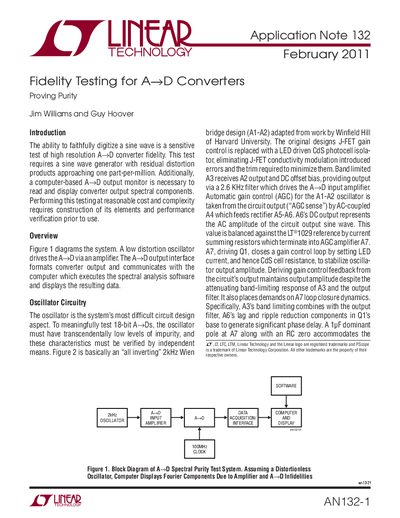
The document details the design of a Wien bridge oscillator with an LED-driven CdS photocell gain control to achieve extremely low distortion levels suitable for testing 18-bit A/D converters. The text explains how this specific circuit eliminates J-FET conductivity modulation errors and maintains stable output amplitude through automatic gain control (AGC).
The note also covers the verification of the oscillator's performance using specialized analyzers like the Audio Precision 2722, noting limitations of standard instruments at low distortion levels. Finally, it presents test results for an LTC2379 A/D converter driven by an LT6350 amplifier, displaying spectral error components and tabulated readings.
The HP-339A specifies a minimum measurable distortion of 18ppm.
The Audio Precision 2722 has a specified limit of 2.5ppm THD+N, with 1.5ppm being typical.
The combination produced a 2nd harmonic distortion of -111dB, which is about 2.8ppm.