
AN131-1 is an application note that introduces the working principle of acoustic thermometer. This thermometer is insensitive to pressure and humidity, so only temperature needs to be measured.
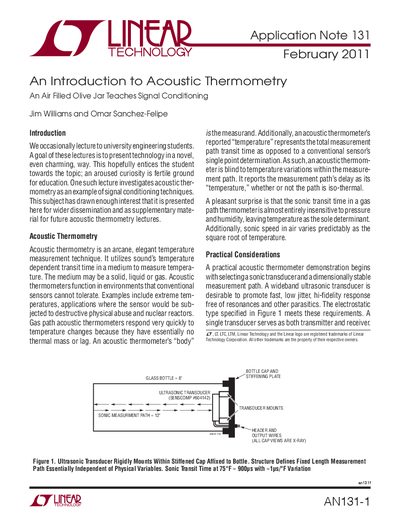
Acoustic thermometry is a temperature measurement technique that utilizes sound's temperature-dependent transit time in a medium. This document presents a practical demonstration using an air-filled glass bottle and ultrasonic transducer to measure temperature via sonic transit time, which is insensitive to pressure and humidity variations.
The note details the system architecture, including a 150V biased electrostatic transducer, a wideband receiver amplifier with high gain, and a microprocessor for calibration. It provides a conceptual overview of the signal conditioning circuitry and includes detailed schematics and waveforms illustrating the start pulse generation, acoustic transit, and trigger gating mechanisms.
| Bias Voltage | 150Vpc |
|---|---|
| Measurement Path Length | 12 inches |
| Two-way Trip Time | around 900s |
| Temperature Variation Rate | ~1ps/°F at 75°F |
| Required Dimensional Stability | inside 100ns |
It is a temperature measurement technique that utilizes sound's temperature dependent transit time in a medium.
No, the sonic transit time in this gas path thermometer is almost entirely insensitive to pressure and humidity.