
The AT24C256B is a serial EEPROM memory with features including low-voltage and standard-voltage operation, internally organized as 32,768 x 8, a two-wire serial interface, Schmitt trigger, filtered inputs for noise suppression, bidirectional data transfer protocol, etc.
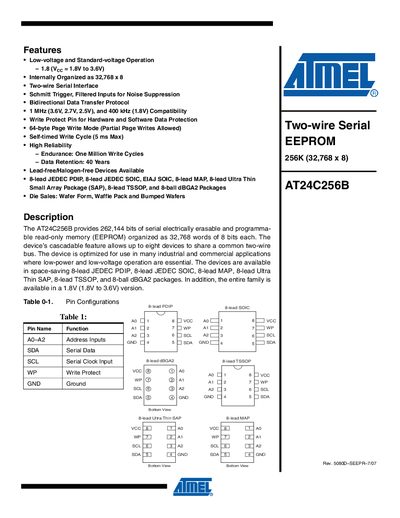
This document is a technical datasheet for the Atmel AT24C256B, a two-wire serial electrically erasable and programmable read-only memory (EEPROM). The device provides 262,144 bits of storage organized as 32,768 words of 8 bits each. It features low-voltage operation ranging from 1.8V to 3.6V and supports clock frequencies up to 1 MHz at higher voltages or 400 kHz at 1.8V.
The datasheet details the device's pin configurations, including address inputs (A2, A1, AO) for cascading up to eight devices on a single bus, and a write protect input (WP). It specifies absolute maximum ratings, DC characteristics such as supply current and voltage levels, and AC timing parameters like clock frequency limits and write cycle times. The document also covers device operation protocols, including start/stop conditions, acknowledge sequences, and software reset procedures.
| Storage Capacity | 262,144 bits (32,768 x 8) |
|---|---|
| Operating Voltage | 1.8V to 3.6V |
| Clock Frequency | Up to 1 MHz at 3.6V, 400 kHz at 1.8V |
| Write Cycle Time | 5 ms Max |
| Endurance | One Million Write Cycles |
| Data Retention | 40 Years |
The device supports one million write cycles.
Data can be retained for up to 40 years.
The maximum clock frequency is 400 kHz when operating at 1.8V.