
The BD7830NUV is a monaural speaker amplifier developed by ROHM for use in portable navigation and mobile audio products. It operates at low voltage and consumes 0µA in standby mode. It also switches quickly and quietly from standby to ON, making it ideal for applications where there is frequent switching between standby and ON.
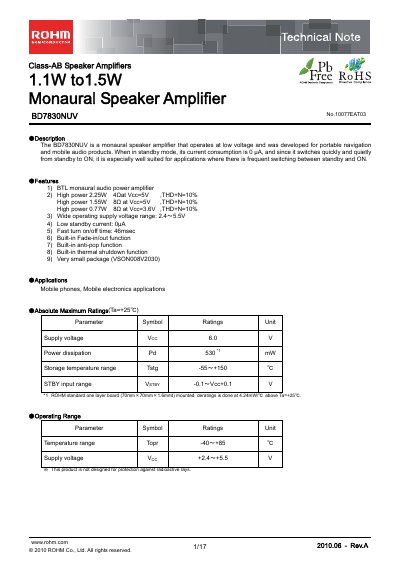
The BD7830NUV is a monaural speaker amplifier designed for portable navigation and mobile audio products. It operates from a low supply voltage, offers fast standby‑to‑on transition, and includes built‑in fade‑in/out, anti‑pop, and thermal shutdown functions.
The document contains detailed electrical characteristics, pinout tables, recommended external components, layout dimensions, and ordering information. It also explains the operation of the STBY and SOFT pins, and provides example application circuits.
| Supply voltage range | 2.4 V ~ 5.5 V |
|---|---|
| Low standby current | 0 µA |
| Fast turn‑on/off time | 46 ms |
| Output power (typical) | 2.25 W at 5 V |
| THD+N (typical) | 0.1 % |
The standby current is 0 µA.
Connect a capacitor to the SOFT pin (pin 3); the capacitor value determines the fade‑in/out duration.
The device operates from 2.4 V to 5.5 V.
It can deliver up to 2.25 W.