
The product is the world's first megapixel CCD imager, M1, developed by Kodak in 1987. It was incorporated into a standard 35 mm camera body by a US government customer under contract with the Federal Systems Division (FSD) to create the first megapixel portable digital camera, truly the prototype of the digital camera system (DCS) product line.
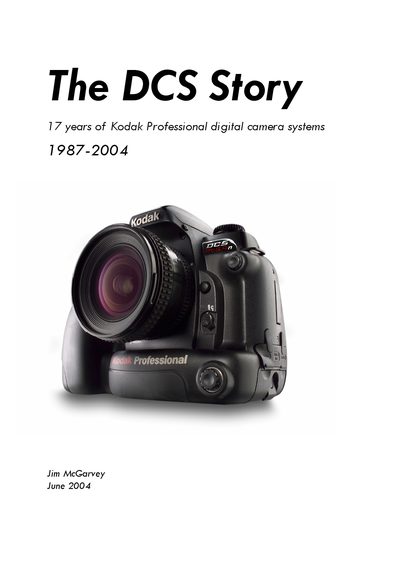
The document chronicles the evolution of Kodak’s Professional Digital Camera System (DCS) from the first megapixel prototype in 1987 through a series of models released up to 2004. It describes early experimental cameras such as the Electro‑Optic Camera, Tactical Camera, and Hawkeye II accessory, noting their technical features and limited production runs.
Later sections detail the commercial DCS 200, AP NC2000, and subsequent DCS generations, highlighting hardware specifications, body choices (Canon, Nikon), and the shift toward more compact, user‑friendly designs. The narrative ends with a model list summarizing the many variants produced over the 17‑year span.
| Sensor (M1) | Monochrome KAF‑1400, 1320 × 1035 pixels, 6.8 µm |
|---|---|
| Buffer memory | 10 Mbyte buffer for 6‑image burst |
| Internal storage | 100 Mbyte SCSI hard drive (holds 60 images) |
| A/D converter | 10‑bit logarithmic amplifier |
It used the M1 megapixel CCD imager, a monochrome KAF‑1400 sensor with 1320 × 1035 pixels and 6.8 µm pixel size.
The early prototypes were built into a Canon F1 film camera body.
Images were transferred by docking the black‑box unit onto an Exabyte 8 mm SCSI tape archive unit.
The DCS 200 was announced at MacWorld Boston in August 1992.