
The NCV8505 is a family of precision micropower voltage regulators with an output current capability of 400mA. The family offers output voltage options for Adjustable, 2.5V, 3.3V, and 5.0V. The output voltage is accurate within ±2.0% with a maximum dropout voltage of 0.6V at 400mA. Low quiescent current is a feature, drawing less than 1.0µA with ENABLE = 0V. With ENABLE = 5.0V, the part only draws 200µA with a 100µA load. This part is ideal for any and all battery-operated microprocessor equipment. The microprocessor control logic includes an active RESET (with DELAY). The active RESET circuit operates correctly at an output voltage as low as 1.0V. The RESET function is activated during the power-up sequence or during normal operation if the output voltage drops below the regulation limits. The regulator is protected against reverse battery, short circuit, and thermal overload conditions. The device can withstand load dump transients, making it suitable for use in automotive environments. The device has also been optimized for EMC conditions.
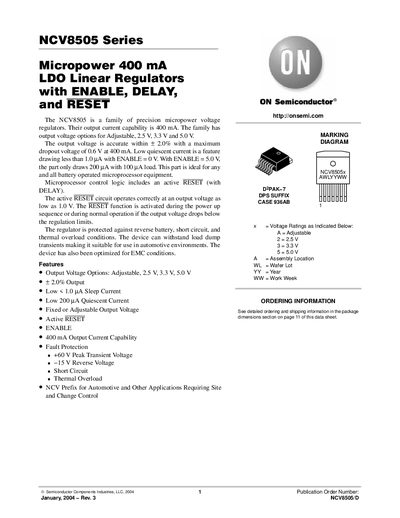
The NCV8505 series from ON Semiconductor provides precision micropower voltage regulation for battery‑operated equipment. It delivers up to 400 mA output current with selectable output voltages of 2.5 V, 3.3 V, 5.0 V or an adjustable setting, and maintains accuracy within ±2.0%.
The device includes an active RESET circuit, ENABLE control, and protection against reverse battery, short‑circuit, and thermal overload. It is qualified for automotive load‑dump transients and optimized for EMC performance.
| Maximum Output Current | 400 mA |
|---|---|
| Output Voltage Options | Adjustable, 2.5 V, 3.3 V, 5.0 V |
| Quiescent Current (Sleep Mode) | < 1.0 µA |
| Quiescent Current (Active Mode, ENABLE=5 V) | 200 µA |
| Peak Transient Voltage | +60 V |
| Reverse Voltage | -15 V |
| Input Voltage Range | -15 V to 45 V |
| Operating Temperature Range (Junction) | -40 °C to +150 °C |
The device can supply up to 400 mA of output current.
It offers Adjustable, 2.5 V, 3.3 V, and 5.0 V output options.
It is protected against reverse battery, short‑circuit, and thermal overload, and can handle load‑dump transients.