
Introduces how to measure aperture uncertainty in ADCs in RF sampling
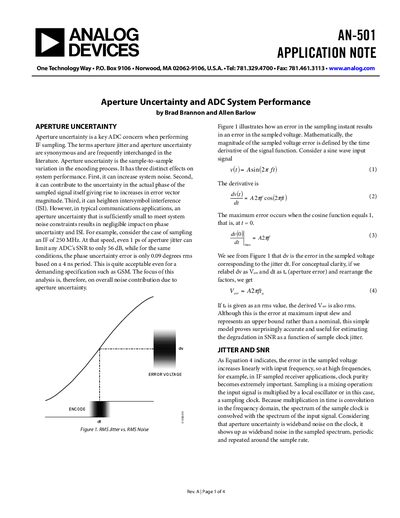
The document explains aperture uncertainty (also called aperture jitter) as the sample‑to‑sample variation in the encoding process of an ADC and describes its three main effects on system performance: increased noise, phase uncertainty, and intersymbol interference. It provides equations and examples that relate jitter to signal‑to‑noise ratio (SNR) and shows how jitter limits the achievable dynamic range at high input frequencies.
Practical measurement methods are presented, including low‑frequency baseline SNR measurements and high‑frequency FFT analysis using the AD9246 evaluation board. The note also covers clock distribution techniques, comparing passive divider/transformer methods with active logic‑gate fan‑out and the AD9510 clock synthesis solution, and quantifies typical jitter contributions of various gate families.
Aperture uncertainty is the sample‑to‑sample variation in the encoding process of an ADC.