
This document discusses the implementation of RS-485/RS-422 in an industrial environment. Applications for RS-485/RS-422 include process control networks, industrial automation, remote terminals, building automation, motor control, and motion control.
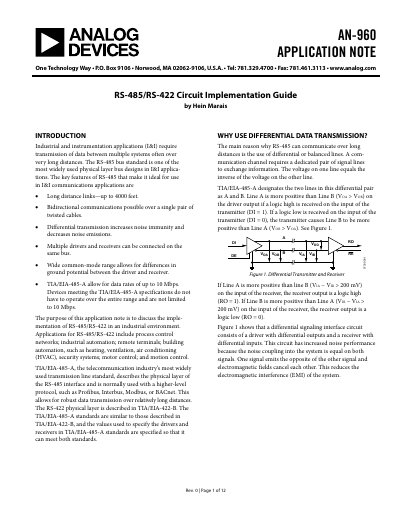
The AN‑960 application note provides an overview of RS‑485 and RS‑422 differential transmission, describing why differential data transmission is advantageous for long‑distance, noise‑immune communication in industrial environments. It compares the two standards, outlines the unit‑load concept, and discusses half‑duplex and full‑duplex bus configurations.
The document then covers practical design topics such as proper termination, fail‑safe biasing, isolation techniques, and transient over‑voltage protection. It includes tables of receiver input impedances, unit‑load capacities, and cable‑length versus data‑rate guidelines, as well as references to relevant IEC standards and Analog Devices product families.
| RS‑485 receiver input impedance | ≥12 kΩ |
|---|---|
| RS‑485 unit‑load capacity | 32 UL |
| RS‑422 receiver input impedance | ≥4 kΩ |
| RS‑422 common‑mode voltage range | ±7 V |
| RS‑485 common‑mode voltage range | −7 V to +12 V |
| Differential input threshold voltage | ±200 mV |
| Maximum RS‑422 data rate | up to 10 Mbps |
A standard RS‑485 receiver can sustain up to 32 unit loads (32 UL).
Termination resistors should be placed at the master node and at the slave node farthest from the master.