
This document introduces a small and thin ±2 g accelerometer, ADXL322. The product has a resolution of 2 mg at 60 Hz. It features a wide supply voltage range, low power consumption, good zero g bias stability, and sensitivity accuracy. The accelerometer is suitable for cost-sensitive motion and tilt sensing applications, such as smart handheld devices, mobile phones, sports and health-related devices, PC security, and PC peripherals.
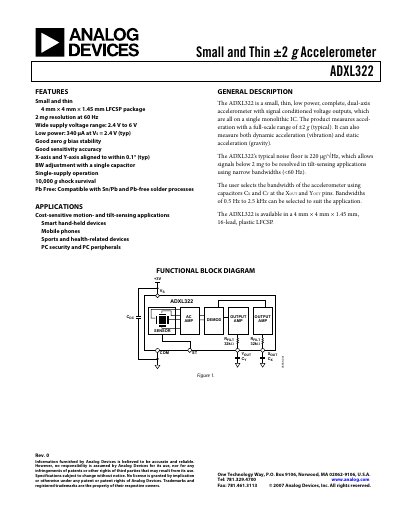
This document describes the ADXL322, a small, thin, low‑power dual‑axis accelerometer with signal‑conditioned voltage outputs. It includes the full specification table, absolute maximum ratings, pin configuration, typical performance curves, and recommended soldering profile.
The datasheet also covers bandwidth selection using external capacitors, self‑test operation, use as a tilt sensor, mechanical dimensions, and ordering information. Application notes for motion‑ and tilt‑sensing in handheld devices, mobile phones, and PC peripherals are provided.
| Measurement Range | ±2 g |
|---|---|
| Sensitivity (typical) | 378‑462 mV/g |
| Noise Density | 220 μg/√Hz |
| Operating Voltage Range | 2.4 V to 6 V |
| Quiescent Supply Current | 0.45 mA |
| Operating Temperature Range | -20 °C to +70 °C |
| Absolute Maximum Acceleration | 10,000 g |
Bandwidth is selected by connecting external capacitors C_X and C_Y to the X_OUT and Y_OUT pins.
The typical noise floor is 220 μg/√Hz at 25 °C.
The quiescent supply current is about 0.45 mA at 3 V.
Yes, it can be used as a dual‑axis tilt sensor by interpreting the X and Y outputs as roll and pitch angles.