
The µPD168110 is a monolithic 2-channel H bridge driver that consists of a CMOS controller and a MOS output stage. It can reduce the current consumption and the voltage loss at the output stage compared with a conventional driver using bipolar transistors, thanks to employment of a MOS process. This product employs a P-channel MOSFET on the high side of the output stage, eliminating a charge pump. As a result, the circuit current consumption can be substantially reduced during operation. This product is ideal for driving the motor of a digital still camera as it can switch over between two-phase excitation driving and microstep driving, using a stepper motor.
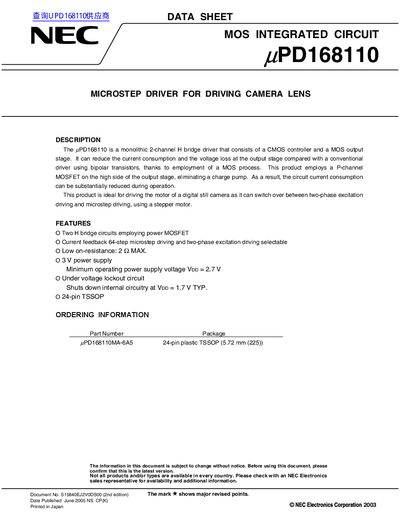
The NEC uPD168110 is a monolithic 2‑channel H‑bridge driver that combines a CMOS controller with a MOS output stage. It reduces current consumption and voltage loss compared with conventional bipolar drivers, using a P‑channel MOSFET on the high side and eliminating a charge pump.
The device supports both two‑phase excitation and 64‑step microstep driving for stepper motors, making it suitable for digital still‑camera lens applications. Detailed pin functions, timing charts, and recommended soldering conditions are provided for designers.
| H‑bridge circuits | Two, employing power MOSFET |
|---|---|
| Microstep resolution | 64 steps |
| Supply voltage (typical) | 3 V |
| Minimum operating voltage | 2.7 V |
| Under‑voltage lockout threshold | 1.7 V typ |
| Package | 24‑pin plastic TSSOP |
| Package type | 24‑pin TSSOP |
The minimum operating power supply voltage is 2.7 V.
It is supplied in a 24‑pin plastic TSSOP package.
Yes, it shuts down internal circuitry when the supply drops to 1.7 V typ.