
TS809/810/809R/810R series microprocessor reset circuit is a microprocessor (µP) supervisory circuit used to monitor the power supplies in µP and digital systems. It provides excellent circuit reliability and low cost by eliminating external components and adjustments when used with +5V, +3.3V, +3.0V powered circuits.
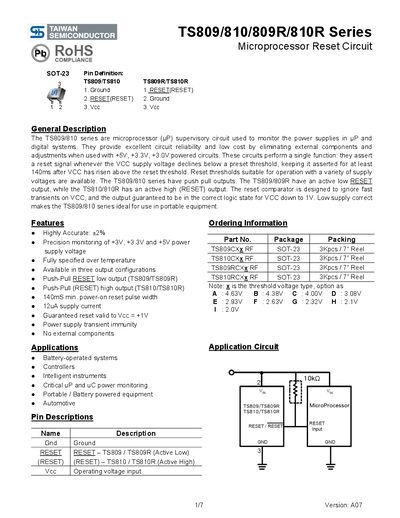
The TS809/810 series are microprocessor supervisory circuits that monitor power supplies in UP and digital systems. They generate a reset signal when VCC falls below a preset threshold and keep it asserted for at least 140 ms after VCC rises above the threshold. The series offers both active‑low (TS809/809R) and active‑high (TS810/810R) push‑pull reset outputs and operates down to 1 V.
The document includes pin definitions, absolute maximum ratings, electrical specifications, ordering information, and application notes. Mechanical drawings of the SOT‑23 package and marking codes are also provided, along with a notice about product liability and usage restrictions.
| Supply Current | 12 µA |
|---|---|
| Reset Pulse Width (minimum) | 140 ms |
| Maximum Input Current | 20 mA |
The reset pulse width is at least 140 ms.
The device draws approximately 12 µA.