
This document introduces the MKP 1848 DC-Link Vishay Roederstein, including its applications, dimensions, markings, capacitance, rated voltage, insulation resistance, self-inductance, test voltage, operating temperature, and lifetime.
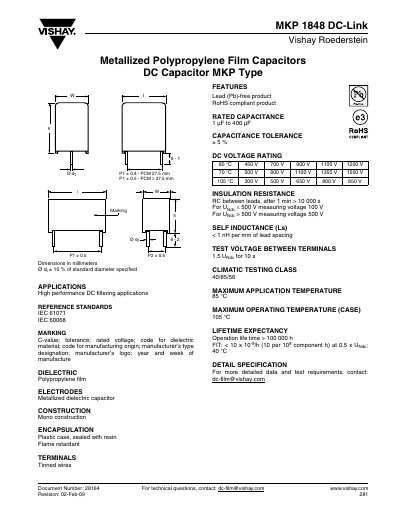
The MKP 1848 DC‑Link series from Vishay Roederstein provides metallized polypropylene film capacitors for high‑performance DC filtering. The devices are lead‑free, RoHS compliant, and available in a range of capacitance values and voltage ratings.
The data sheet includes dimensions, electrical characteristics, temperature limits, lifetime expectancy, and test conditions. It also lists part numbers for various capacitance and voltage options, along with mounting and handling guidelines.
| Capacitance range | 1 µF to 400 µF |
|---|---|
| Capacitance tolerance | ± 5 % |
| Insulation resistance | > 10 000 s after 1 min |
| Self inductance | < 1 nH per mm of lead spacing |
| Maximum operating temperature (case) | 105 °C |
| Lifetime expectancy | > 100 000 h |
| Environmental compliance | Lead‑free, RoHS compliant |
The capacitance tolerance is ± 5 %.
The expected lifetime is greater than 100 000 hours.
The maximum operating temperature of the case is 105 °C.