
This document describes the A.S.DTM SMTHDTxx TRISIL discrete solution for ISDN protection. The products feature dual bidirectional protection, low capacitance, and good capacitance balance.
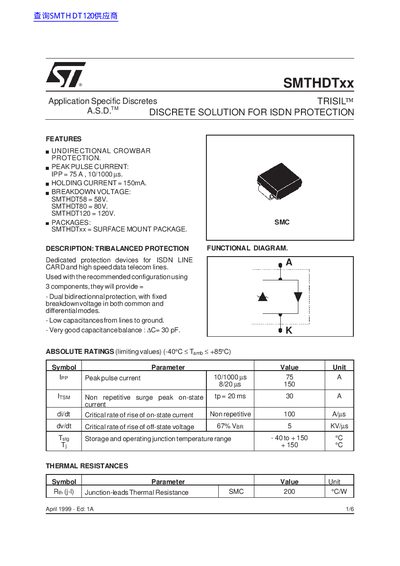
The SMTHDTxx family offers application‑specific discrete protection for ISDN and high‑speed data telecom lines. Features include a unidirectional crowbar protection, peak pulse current of 75 A, holding current of 150 mA, and breakdown voltages of 58 V, 80 V, or 120 V depending on the model.
The document lists absolute ratings, thermal resistances, diode parameters, and detailed test procedures. It also includes package mechanical data, order‑code markings, and application notes describing recommended configurations and capacitance characteristics.
| Peak pulse current | 75 A |
|---|---|
| Holding current | 150 mA |
| Breakdown voltage (SMTHDT58) | 58 V |
| Breakdown voltage (SMTHDT80) | 80 V |
| Breakdown voltage (SMTHDT120) | 120 V |
| Forward voltage drop (Ve) | 5 V |
The peak pulse current rating is 75 A for a 10 µs/1000 µs pulse.
The holding current is specified as 150 mA.
The SMTHDT80 has a breakdown voltage of 80 V.
The order‑code marking for SMTHDT58 is "SMTHDT58 Wwo01".