
LT1078/LT1079 are micropower, dual and quad, single supply, precision op amps. They feature low supply current, low offset voltage, and low noise.
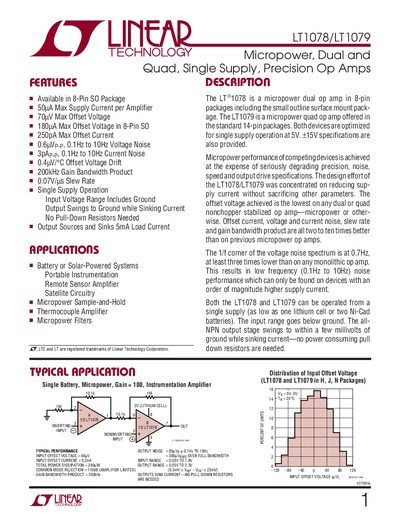
The LT1078 (dual) and LT1079 (quad) are micropower, single‑supply precision operational amplifiers offered in 8‑pin SO and 14‑pin packages. They feature ultra‑low offset voltage, low noise, and can operate from a single 5 V supply, making them suitable for battery‑powered instrumentation, sensor interfaces and satellite circuitry.
The document provides detailed electrical characteristics, absolute maximum ratings, typical performance graphs, and package dimensions for each variant, along with typical application circuits and ordering information.
| Supply Current per Amplifier | 50 µA max |
|---|---|
| Gain Bandwidth Product | 200 kHz |
| Slew Rate | 0.07 V/µs |
| Output Load Current | 5 mA |
| Input Offset Voltage (LT1078) | 30 µV min – 70 µV typ – 40 µV max |
Each amplifier draws up to 50 µA of supply current.
The gain‑bandwidth product is specified as 200 kHz.
The devices have a slew rate of 0.07 V/µs.
They can source or sink a load current of up to 5 mA.