
This document describes the features and applications of the ADS8327 and ADS8328, low power, 16-bit, 500kHz, single/dual unipolar input analog-to-digital converters with a serial interface.
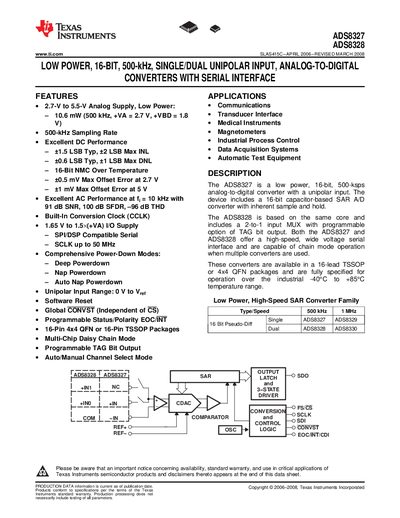
The ADS8327 and ADS8328 are low‑power, 16‑bit, 500‑kS/s analog‑to‑digital converters with unipolar input ranges. They offer high‑speed serial interfaces, multiple power‑down modes, and are available in 16‑lead TSSOP or 4×4 QFN packages.
These converters are suited for communications, transducer interfaces, medical instruments, magnetometers, industrial process control, data acquisition, and automatic test equipment. Ordering information, absolute maximum ratings, and detailed mechanical drawings are included in the document.
| Resolution | 16 Bits |
|---|---|
| Maximum Sampling Rate | 500 kHz |
| Power Dissipation (typical, +VA=2.7 V, +VBD=1.8 V) | 10.6 mW |
| Operating Temperature Range | -40 °C to 85 °C |
| Input Range (Unipolar) | 0 V to VIO |
The converters support a maximum sampling rate of 500 kHz.
The devices provide Deep Powerdown, Nap Powerdown, and Auto‑Nap Powerdown modes.
Both parts are available in 16‑lead TSSOP or 4×4 QFN packages.
Typical power consumption is 10.6 mW at 500 kS/s with +VA = 2.7 V and +VBD = 1.8 V.