
The MAX7310 is a 2-wire interfaced 8-bit I/O port expander with reset. It provides 8-bit parallel input/output port expansion for SMBus-compatible and I2C-compatible applications. The MAX7310 consists of an input port register, an output port register, a polarity inversion register, a configuration register, a bus timeout register, and an SMBus/I2C-compatible serial interface. The system master can invert the MAX7310 input data by writing to the active-high polarity inversion register. The system master can enable or disable bus timeout by writing to the bus timeout register. Any of the eight I/O ports may be configured as input or output. An active-low reset input sets the eight I/Os as inputs. Three address select pins configure one of 56 slave ID addresses. The MAX7310 is available in 16-pin thin QFN, TSSOP, and QSOP packages and is specified over the -40°C to +125°C automotive temperature range.
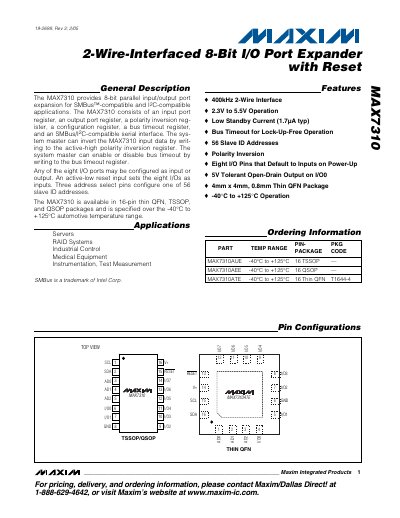
The MAX7310 is an 8‑bit parallel I/O port expander that operates over an I²C/SMBus‑compatible two‑wire interface. It provides input, output, polarity‑inversion, configuration and timeout registers, and supports up to 56 selectable slave addresses.
The device is offered in 16‑pin thin QFN, TSSOP and QSOP packages and is rated for automotive temperature ranges. Electrical characteristics include a 2.3 V‑5.5 V supply range, 400 kHz SCL clock, 30‑60 ms bus timeout, and a typical standby current of 1.7 µA.
| Supply Voltage (V+) | 2.3 V to 5.5 V |
|---|---|
| Operating Temperature Range | -40 °C to +125 °C |
| Number of I/O Pins | 8 |
| Standby Current | Typical 1.7 µA |
| Package Types | 16‑pin thin QFN, TSSOP, QSOP |
| Slave ID Addresses | 56 selectable addresses |
The device operates from 2.3 V up to 5.5 V.
Three address pins allow selection of one of 56 possible slave IDs.
Typical standby current is about 1.7 µA.
It forces all eight I/O pins to become inputs.