
The MAX7325 is a 2-wire serial-interfaced peripheral with 16 I/O ports. The ports are divided into eight push-pull outputs and eight I/Os with selectable internal pullups and transition detection. Eight ports are push-pull outputs and eight I/Os may be used as a logic input or an open-drain output. The ports are overvoltage protected to +6V. All I/O ports configured as inputs are continuously monitored for state changes (transition detection). State changes are indicated by the INT output. The interrupt is latched, allowing detection of transient changes. When the MAX7325 is subsequently accessed through the serial interface, any pending interrupt is cleared. The open-drain outputs are rated to sink 20mA and are capable of driving LEDs. The RST input clears the serial interface, terminating any I2C communication to or from the MAX7325. The MAX7325 uses two address inputs with four-level logic to allow 16 I2C slave addresses. The slave address also determines the power-up logic state for the I/O ports and enables or disables internal 40kΩ pullups in groups of four ports. The MAX7325 is one device in a family of pin-compatible port expanders with a choice of input ports, open-drain I/O ports, and push-pull output ports (see Table 1). The MAX7325 is available in 24-pin QSOP and TQFN packages and is specified over the -40°C to +125°C automotive temperature range.
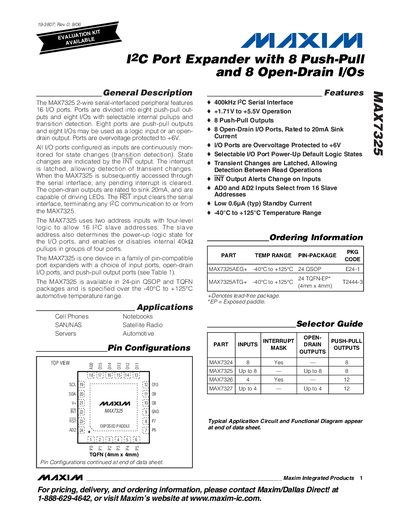
The MAX7325 is a 2‑wire serial‑interfaced port expander that provides sixteen I/O pins: eight push‑pull outputs and eight open‑drain I/Os. Each open‑drain output can sink 20 mA and the device includes over‑voltage protection up to +6 V. The part operates from a supply voltage of 1.71 V to 5.5 V and supports I²C bus speeds up to 400 kHz.
The device offers selectable internal pull‑up resistors, transition‑detection interrupt logic, and a programmable address via the ADO and AD2 pins, allowing up to sixteen slave addresses. It is available in 24‑pin QSOP and 4 mm × 4 mm TQFN packages and is rated for automotive temperature ranges from –40 °C to +125 °C.
| Serial‑Clock Frequency | 400 kHz |
|---|---|
| Open‑Drain Output Sink Current | 20 mA |
| Overvoltage Protection | +6 V |
| Operating Temperature Range | -40 °C to +125 °C |
| Package Options | 24‑pin QSOP, 4 mm×4 mm TQFN |
| Total I/O Ports | 16 (8 push‑pull, 8 open‑drain) |
| Standby Current (typical) | 0.6 pA |
The MAX7325 supports I²C clock frequencies up to 400 kHz.
The device provides sixteen I/O ports: eight push‑pull outputs and eight open‑drain I/Os.
The output ports are protected against voltages up to +6 V.