
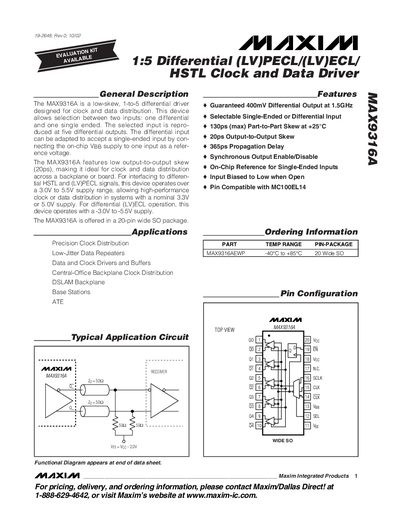
The MAX9316A is a low-skew, 1-to-5 differential driver designed for clock and data distribution. This device allows selection between two inputs: one differential and one single ended. The selected input is reproduced at five differential outputs. The differential input can be adapted to accept a single-ended input by connecting the on-chip VBB supply to one input as a reference voltage. The MAX9316A features low output-to-output skew (20ps), making it ideal for clock and data distribution across a backplane or board. For interfacing to differential HSTL and (LV)PECL signals, this device operates over a 3.0V to 5.5V supply range, allowing high-performance clock or data distribution in systems with a nominal 3.3V or 5.0V supply. For differential (LV)ECL operation, this device operates with a -3.0V to -5.5V supply. The MAX9316A is offered in a 20-pin wide SO package. Applications include precision clock distribution, low-jitter data repeaters, data and clock drivers and buffers, central-office backplane clock distribution, DSLAM backplane, base stations and ATE. Features include guaranteed 400mV differential output at 1.5GHz, selectable single-ended or differential input, 130ps (max) part-to-part skew at +25°C, 20ps output-to-output skew, 365ps propagation delay, synchronous output enable/disable, on-chip reference for single-ended inputs, input biased to low when open, pin compatible with MC100EL14.
The MAX9316A provides low output‑to‑output skew (20 ps) and low propagation delay (365 ps), making it suitable for high‑performance clock and data distribution across backplanes or boards. It supports both differential (LV)PECL/(LV)ECL and HSTL signaling with a supply range of 3.0 V to 5.5 V (or –3.0 V to –5.5 V for LV‑ECL).
The device includes a 2‑to‑1 MUX for selecting between two clock inputs, synchronous enable/disable, and on‑chip reference voltages for single‑ended operation. It is supplied in a 20‑pin wide SO package and is pin‑compatible with MC100EL14.