
The MXL1543 is a three-driver/three-receiver multiprotocol transceiver that operates from a +5V single supply. The MXL1543, along with the MXL1544/MAX3175 and the MXL1344A, form a complete software-selec- table data terminal equipment (DTE) or data communi- cation equipment (DCE) interface port that supports the V.28 (RS-232), V.10/V.11 (RS-449/V.36, EIA-530, EIA- 530A, X.21), and V.35 protocols. The MXL1543 trans- ceivers carry the high-speed clock and data signals while the MXL1544/MAX3175 carry the control signals. The MXL1543 can be terminated by the MXL1344A software-selectable resistor termination network or by discrete termination networks. An internal charge pump and a proprietary low-dropout transmitter output stage allow V.11- , V.28- , and V.35- compliant operation from a +5V single supply. A no- cable mode is entered when all mode pins (M0, M1, and M2) are pulled high or left unconnected. In no- cable mode, supply current decreases to 0.5µA and all transmitter and receiver outputs are disabled (high impedance). Short-circuit current limiting and thermal shutdown circuitry protect the drivers against excessive power dissipation.
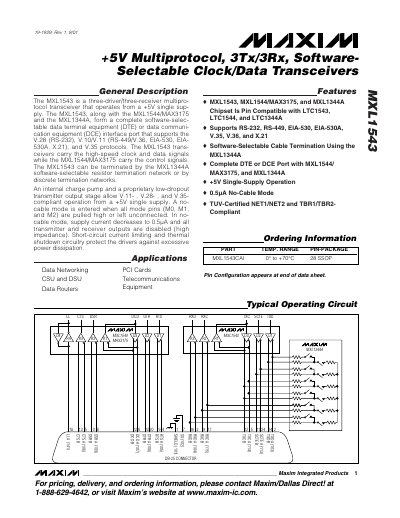
The MXL1543 is a three‑driver/three‑receiver multiprotocol transceiver that operates from a single +5 V supply. It forms a complete DTE or DCE interface together with the MXL1544/MAX3175 and MXL1344A and supports V.28 (RS‑232), V.10/V.11 (RS‑449/V.36, EIA‑530, EIA‑530A, X.21) and V.35 protocols.
The device features software‑selectable cable termination, a no‑cable mode with 0.5 µA standby current, short‑circuit current limiting, and thermal‑shutdown protection. Pin‑selectable mode pins (M0‑M2) determine the active protocol, and the internal dual charge‑pump provides both positive and negative supply rails.
| Supply Voltage (VCC) | 4.75 V – 5.25 V |
|---|---|
| No‑cable Mode Supply Current | 0.5 µA |
| Operating Temperature Range | 0 °C – 70 °C |
| Output High Voltage (R1OUT typical) | 4.5 V |
It supports V.28 (RS‑232), V.10/V.11 (RS‑449/V.36, EIA‑530, EIA‑530A, X.21) and V.35 protocols.
No‑cable mode is entered when all mode‑select pins M0, M1 and M2 are pulled high or left unconnected.
The device includes short‑circuit current limiting and thermal‑shutdown circuitry to protect the drivers from excessive power dissipation.
The supply current drops to 0.5 µA in no‑cable mode.