
The CAT5419 is two Digitally Programmable Potentiometers (DPP™) integrated with control logic and 16 bytes of NVRAM memory. A separate 6-bit control register (WCR) independently controls the wiper tap position for each DPP. Associated with each wiper control register are four 6-bit non-volatile memory data registers (DR) used for storing up to four wiper settings. Writing to the wiper control register or any of the non-volatile data registers is via a 2-wire serial bus (I2C-like). On power-up, the contents of the CAT5419 Dual Digitally Programmable Potentiometers (DPP™) with 64 Taps and 2-wire Interface FEATURES I Two linear-taper digital potentiometers I 64 resistor taps per potentiometer I End-to-end resistance 2.5kΩ, 10kΩ, 50kΩ or 100kΩ I Potentiometer control and memory access via 2-wire interface (I2C like) I Low wiper resistance, typically 80ΩΩΩΩΩ I Four non-volatile wiper settings for each potentiometer I Recall of wiper settings at power up I 2.5 to 6.0 volt operation I Standby current less than 1µA I 1,000,000 nonvolatile WRITE cycles I 100 year nonvolatile memory data retention I 24-lead SOIC, 24-lead TSSOP and BGA I Write protection for data register
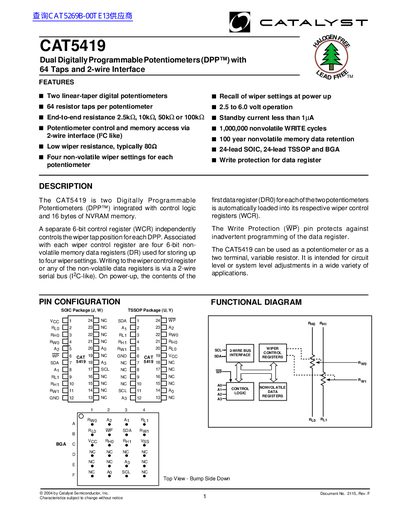
The CAT5419 is a dual digitally programmable potentiometer (DPP) featuring 64 resistor taps per potentiometer and a 2‑wire serial interface compatible with I2C. It includes four non‑volatile wiper settings, write protection, and up to 100‑year data retention, making it suitable for circuit‑level adjustments.
The device operates from 2.5 V to 6.0 V, provides a standby current of less than 1 µA, and supports up to 1 000 000 write cycles. It can be addressed on a shared bus with up to sixteen devices, and its pins are available in SOIC, TSSOP, and BGA packages.
| Number of taps per potentiometer | 64 |
|---|---|
| End‑to‑end resistance options | 2.5 kΩ, 10 kΩ, 50 kΩ, 100 kΩ |
| Non‑volatile write cycles | 1,000,000 cycles |
| Data retention | 100 years |
| Operating voltage | 2.5 V to 6.0 V |
The CAT5419 uses a 2‑wire serial bus (I2C‑like) for potentiometer control and memory access.
The write cycle time is specified as 5 ms.