
Product name: CBR1-D010, Supplier information: 145 Adams Avenue, Hauppauge, NY 11788 USA Tel: (631) 435-1110 • Fax: (631) 435-1824
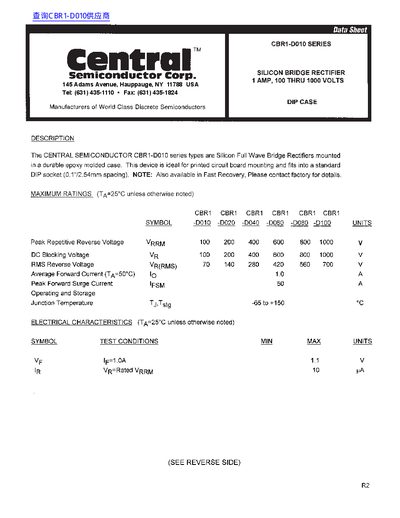
The CBR1-D010 series are silicon full‑wave bridge rectifiers supplied in a durable epoxy‑molded DIP case. They are designed for printed‑circuit‑board mounting and fit standard 0.1 in/2.54 mm spaced DIP sockets.
Maximum voltage ratings range from 100 V to 1000 V depending on the specific part number, with an average forward current of 1 A (at 50 °C) and a peak forward surge current of 50 A. Electrical characteristics include a forward voltage drop of 1.4 V at 1 A and a junction temperature range of –65 °C to +150 °C. Mechanical dimensions are provided in inches.
| Peak Repetitive Reverse Voltage (VRRM) | 100‑1000 V |
|---|---|
| DC Blocking Voltage (VBR) | 100‑1000 V |
| RMS Reverse Voltage (VR RMS) | 70‑700 V |
| Average Forward Current (Ta=50 °C) | 1.0 A |
| Peak Forward Surge Current (IFSM) | 50 A |
| Junction Temperature Range | -65 °C to +150 °C |
| Forward Voltage Drop (Vf) at If=1 A | 1.4 V |
| Package Type | DIP epoxy‑molded case |
| Pin Spacing | 0.1 in / 2.54 mm |
The series is available with peak repetitive reverse voltages ranging from 100 V to 1000 V depending on the part number.
The average forward current is rated at 1.0 A when the junction temperature is 50 °C.
It is supplied in a durable epoxy‑molded DIP case that fits a standard DIP socket.