
This datasheet provides information about Analog Devices ADM222/ADM232A/ADM242, including features, applications, and pinout diagram.
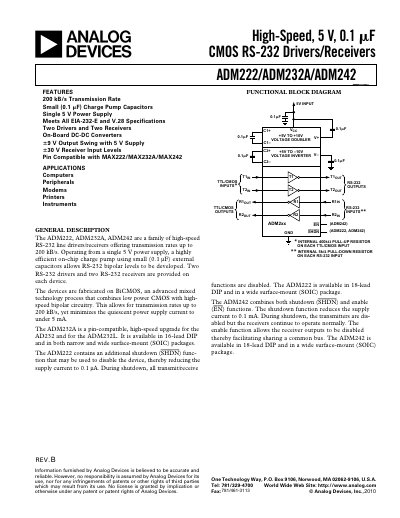
The ADM222, ADM232A, and ADM242 are a family of high‑speed RS‑232 line drivers and receivers that operate from a single 5 V supply and use an on‑chip charge pump with 0.1 µF external capacitors to generate bipolar RS‑232 levels. Each device contains two drivers and two receivers, and the series offers shutdown and enable functions to reduce power consumption.
Key features include a 200 kB/s data rate, ±5 V to ±9 V output swing, low‑power operation (under 5 mA quiescent current), and pin‑compatible packages (DIP and SOIC). Detailed electrical specifications, absolute maximum ratings, and mechanical dimensions are provided for design integration.
| Data Rate | 200 kB/s |
|---|---|
| Supply Voltage | 5 V |
| Output Voltage Swing | ±5 V to ±9 V |
| Number of Drivers per Device | 2 |
| Number of Receivers per Device | 2 |
The devices support a maximum data rate of 200 kB/s.
Each device provides two RS‑232 drivers and two RS‑232 receivers.
The devices operate from a single 5 V power supply.