
The SMT15E series is a non-isolated DC-DC converter packaged in a surface-mount footprint that gives designers a cost-effective solution for conversion from either a 3.3 Vdc or 5 Vdc input to output voltages of 0.8 Vdc and 3.63 Vdc. The SMT15E offers a range of fixed outputs (and one wide trim output unit) at an industry-leading 15 A, which allows maximum design flexibility and a pathway for future upgrades. Local voltage conversion by the SMT15E series from existing 3.3 Vdc or 5 Vdc system voltages eliminates the need for redesign of existing power architectures when voltage requirements change. The SMT15E is designed for applications that include distributed power, workstations, optical network and wireless applications. Implemented using state-of-the-art surface-mount technology and automated manufacturing techniques, the SMT15E offers compact size and efficiencies of up to 96%.
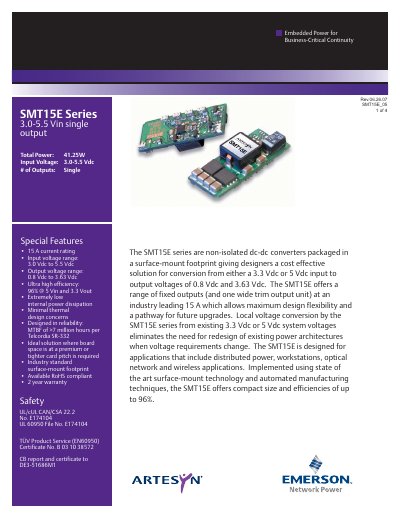
The SMT15E series provides non‑isolated DC‑DC conversion in a compact surface‑mount package. It accepts an input voltage of 3.0‑5.5 Vdc and can be trimmed to output voltages from 0.8 Vdc to 3.63 Vdc, delivering up to 15 A of continuous current. Efficiency reaches as high as 96 % at 5 Vin and 3.3 Vout, making it suitable for space‑constrained designs.
Typical applications include distributed power, workstations, optical networking and wireless equipment. The device meets UL/cUL, CSA and EN60950 safety standards, offers remote ON/OFF control, and is available in RoHS‑compliant versions with a two‑year warranty.
| Input voltage range | 3.0‑5.5 Vdc |
|---|---|
| Output voltage range | 0.8‑3.63 Vdc |
| Maximum output current | 15 A |
| Efficiency | up to 96 % |
| Switching frequency | 300 kHz (typ.) |
| Dimensions (L×W×H) | 33.02 × 13.46 × 8.21 mm |
| Weight | 6.3 g |
| MTBF | >7 million hours |
| Operating temperature range | -40 °C to +100 °C |
The SMT15E accepts an input voltage from 3.0 Vdc to 5.5 Vdc.
The converter can achieve up to 96 % efficiency at 5 Vin and 3.3 Vout.
The device provides a single output.
The standard remote ON/OFF pin uses negative logic; a high level turns the converter off, while a low level turns it on.