
This document describes the features and characteristics of the Precision Four Degrees of Freedom Sensor ADIS16305 Rev. 0, including digital gyroscope, triaxis digital accelerometer, wide sensor bandwidth, autonomous operation and data collection, factory-calibrated sensitivity, bias, and alignment, etc.
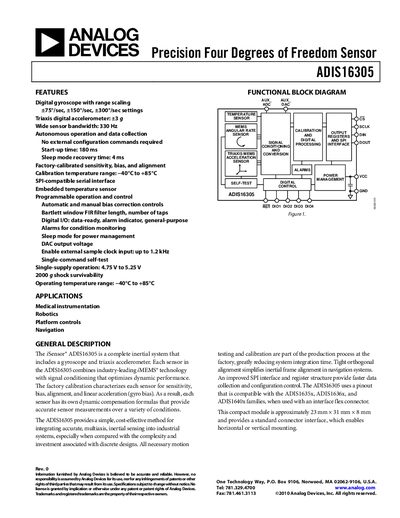
The ADIS16305 is a complete inertial system that integrates a digital gyroscope and a triaxis accelerometer. It is designed for applications such as medical instrumentation, robotics, platform controls, and navigation, offering factory‑calibrated sensitivity, bias, and alignment for accurate measurements.
The datasheet details the sensor’s electrical characteristics, including a single‑supply voltage of 4.75 V to 5.25 V, start‑up time of 180 ms, and sleep‑mode recovery of 4 ms. It also lists mechanical specs like 2000 g shock survivability, operating temperature range of –40 °C to +85 °C, and dimensions of approximately 23 mm × 31 mm × 8 mm. Pin configurations, timing diagrams, and performance graphs are provided for system integration.
| Gyroscope Dynamic Range | +300 °/sec |
|---|---|
| Accelerometer Dynamic Range | +3 g |
| Accelerometer Sensitivity (typical) | 0.6 mg/LSB |
| Power Supply Voltage Range | 4.75 V to 5.25 V |
| Normal Mode Current Consumption | 42 mA |
| Sleep Mode Recovery Time | 4 ms |
| 3 dB Bandwidth | 330 Hz |
| Gyroscope Resonant Frequency | 14.5 kHz |
| Accelerometer Resonant Frequency | 5.5 kHz |
The device starts up in 180 ms in normal mode.
It operates from –40 °C to +85 °C.
The sensor works with a single supply of 4.75 V to 5.25 V.
The device can survive shocks up to 2000 g.