
The LM48411 is a single supply, high efficiency, 2.5W/channel Class D audio amplifier from National Semiconductor. It features the company's unique patented ultra low EMI, spread spectrum, PWM architecture, which significantly reduces RF emissions while preserving audio quality and efficiency. The E2S system also improves battery life, reduces external component count, board area consumption, system cost and simplifies design. The LM48411 is designed to meet the demands of mobile phones and other portable communication devices. Operating on a single 5V supply, it is capable of delivering 2.5W/channel of continuous output power to a 4Ω load with less than 10% THD+N. Its flexible power supply requirements allow operation from 2.4V to 5.5V. The wide band spread spectrum architecture of the LM48411 reduces EMI-radiated emissions due to the modulator frequency. The LM48411 features high efficiency compared to a conventional Class AB amplifier. The E2S system includes an advanced, patented pending edge rate control (ERC) architecture that further reduce emissions by minimizing the high frequency component of the device output, while maintaining high quality audio reproduction and high efficiency (η = 87% at VDD = 3.6V, PO = 500mW). Four gain options are pin se- lectable through GAIN0 and GAIN1 pins.
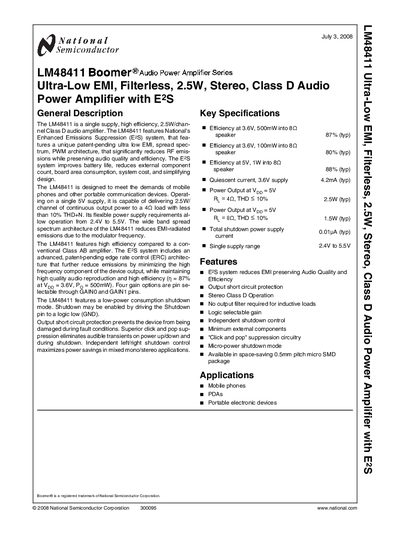
The LM48411 audio power amplifier from National Semiconductor delivers up to 2.5 W per channel into a 4 Ω load while operating from a single 5 V supply. It features the patented Enhanced Emissions Suppression (E2S) system, which reduces RF emissions and improves battery life for portable devices.
The device includes selectable gain options, independent left/right shutdown pins, short‑circuit protection, and a low‑power shutdown mode. It is offered in a 0.5 mm pitch micro‑SMD package and is targeted at mobile phones, PDAs, and other portable electronic applications.
| Quiescent current (typical) | 4.2 mA |
|---|---|
| THD+N (max) | 10 % at 1 kHz, 4 Ω |
Driving the Shutdown pin to a logic low (GND) enables the low‑power shutdown mode.