
The data sheet describes the features of MAX6970, including interface, power supply, and drive current.
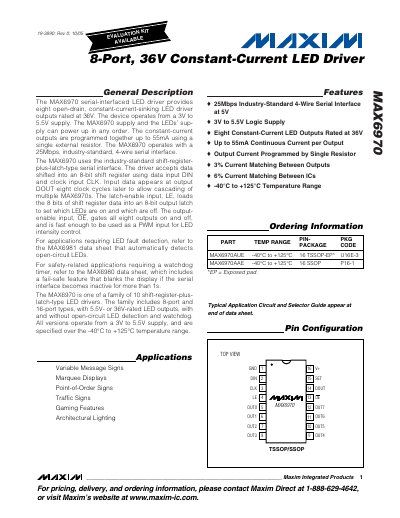
The MAX6970 is an 8‑port, 36 V constant‑current LED driver that operates from a 3 V to 5.5 V supply. It uses a 25 Mbps, 4‑wire serial interface to program up to 55 mA per output via a single external resistor. The device supports open‑drain sinking outputs suitable for static or multiplexed LED applications.
The datasheet provides absolute maximum ratings, electrical characteristics, timing diagrams, pin descriptions, and application guidance. It also includes package information for TSSOP and SSOP variants and outlines power‑dissipation calculations and thermal protection features.
| Number of output ports | 8 |
|---|---|
| Maximum output voltage | 36 V |
| Maximum constant current per output | 55 mA |
| Supply voltage range | 3 V to 5.5 V |
| Interface speed | 25 Mbps 4‑wire serial |
| Operating temperature range | -40 °C to +125 °C |
The MAX6970 can source up to 55 mA per output, programmed by a single external resistor.
It operates from a supply voltage of 3 V to 5.5 V.
The device provides eight open‑drain constant‑current sinking LED driver outputs.