
The TS3USB221A is a high-bandwidth switch specially designed for the switching of high-speed USB 2.0 signals in handset and consumer applications, such as cell phones, digital cameras, and notebooks with hubs or controllers with limited USB I/Os. The wide bandwidth (900 MHz) of this switch allows signals to pass with minimum edge and phase distortion. The device multiplexes differential outputs from a USB host device to one of two corresponding outputs. The switch is bidirectional and offers little or no attenuation of the high-speed signals at the outputs. It is designed for low-power mode when OE is disabled (1 µA), with a maximum rON of 6 Ω, typical ΔrON of 0.2 Ω, typical Cio(on) of 6 pF, and maximum power consumption of 30 µA. It has high bandwidth (typical 900 MHz), latch-up performance exceeding 100 mA per JESD 78 Class II, and ESD performance tested per JESD 22 (7000V human-body model, 1000V charged-device model).
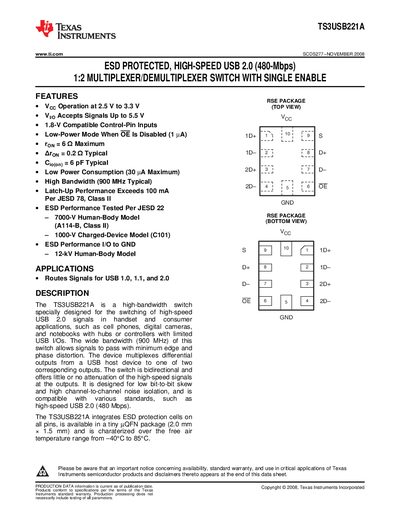
The TS3USB221A is a high‑bandwidth, ESD‑protected 1:2 multiplexer/demultiplexer switch designed for USB 2.0 applications such as cell phones, digital cameras, and notebooks. It operates from 2.3 V to 3.6 V supply, supports 5.5 V I/O, and offers low‑power mode when disabled.
The device is offered in a tiny QFN (2.0 mm × 1.5 mm) package, rated for –40 °C to 85 °C operation. Electrical characteristics include a typical bandwidth of 900 MHz, propagation delay of 0.25 ns, and ESD protection up to 7000 V (human‑body model).
| Supply voltage range (VCC) | 2.3 V – 3.6 V |
|---|---|
| Low‑power consumption | 30 µA maximum |
| Typical bandwidth | 900 MHz |
| Propagation delay | 0.25 ns |
| ESD rating (Human‑Body Model) | 7000 V |
The device operates with a supply voltage (VCC) between 2.3 V and 3.6 V.
The typical bandwidth is 900 MHz, allowing high‑speed USB signals to pass with minimal distortion.
In low‑power mode the device draws up to 30 µA.
It meets a 7000‑V Human‑Body Model rating and a 1000‑V Charged‑Device Model rating.