
This document describes the features of the WirelessUSB™ LS 2.4 GHz DSSS Radio SoC CYWUSB6932 and CYWUSB6934 produced by Cypress Semiconductor Corporation. These chips have a 2.4 GHz radio transceiver that operates in the unlicensed Industrial, Scientific, and Medical (ISM) band (2.4 GHz–2.483 GHz). They have a receive sensitivity of -90 dBm, an output power of up to 0 dBm, a range of up to 10 meters or more, and a data throughput of up to 62.5 kbits/sec. Additionally, these chips are highly integrated, require minimal external components, support an SPI microcontroller interface, and have an operating voltage range of 2.7V to 3.6V and an operating temperature range of 0°C to 70°C.
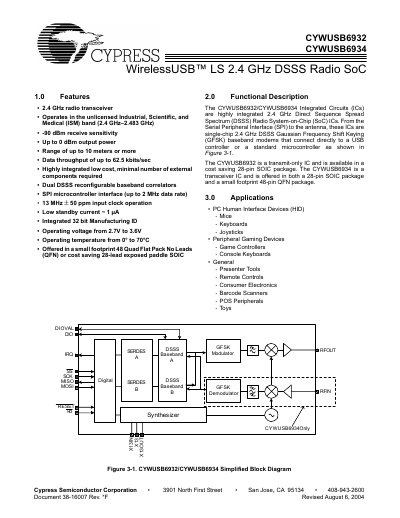
The CYWUSB6932 and CYWUSB6934 are highly integrated 2.4 GHz Direct Sequence Spread Spectrum (DSSS) System‑on‑Chip radio transceivers. They provide a SPI‑controlled radio modem with GFSK modulation, dual DSSS baseband, and optional SERDES or DIO interfaces. The CYWUSB6932 is a transmit‑only device in a 28‑pin SOIC package, while the CYWUSB6934 is a full transceiver offered in both 28‑pin SOIC and 48‑pin QFN packages.
Both devices operate from 2.7 V to 3.6 V, support an operating temperature range of 0 °C to 70 °C, and achieve up to 62.5 kbits/sec data throughput. They include a low‑standby current (~1 µA), -90 dBm receive sensitivity, and up to 0 dBm output power, with a typical range of 10 m or more. The datasheet details register maps, SPI command formats, interrupt handling, and clocking requirements for integration into USB controllers or microcontrollers.
| Operating voltage | 2.7 V to 3.6 V |
|---|---|
| Operating temperature | 0 °C to 70 °C |
| Data throughput | up to 62.5 kbits/sec |
| Receive sensitivity | -90 dBm |
| Output power | up to 0 dBm |
| Standby current | ~1 µA |
| Input clock | 13 MHz ± 50 ppm |
| Package options | 48‑pin QFN or 28‑pin SOIC |
| Maximum range | ≈10 m or more |
| Number of spreading codes | 49 Gold codes across 78 1 MHz channels |
Both devices are powered from a 2.7 V to 3.6 V DC supply.
The devices can achieve a data throughput of up to 62.5 kbits per second.
It supports 49 Gold spreading codes across 78 one‑megahertz channels.