
The ADA4862-3 is a low cost, high speed, internally fixed, G = +2 op amp, ideal for RGB/HD/SD video applications.
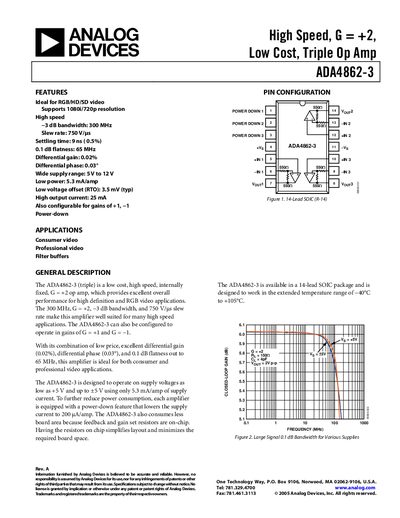
The ADA4862-3 is a low‑cost, high‑speed triple operational amplifier with a fixed gain of G = +2, designed for consumer and professional video applications. It offers a 300 MHz –3 dB bandwidth, 750 V/µs slew rate, and low power consumption (5.3 mA per amplifier) while supporting supply voltages from 5 V to 12 V.
The document includes detailed specifications such as dynamic performance, distortion/noise data, absolute maximum ratings, thermal resistance, and an ordering guide for the 14‑lead SOIC package. A power‑down pin allows the device to enter a low‑power state of about 200 µA, simplifying board layout with on‑chip gain‑setting resistors.
| -3 dB Bandwidth (typ) | 300 MHz |
|---|---|
| Slew Rate (rise) | 750 V/µs |
| Supply Voltage Range | 5 V to 12 V |
| Quiescent Current (enabled, typ) | 14 mA per amplifier |
| Differential Gain | 0.02 % |
| Power‑down Current | 200 µA |
| Absolute Maximum Supply Voltage | 12.6 V |
The device draws about 14 mA per amplifier in its enabled state.
Yes, its operating supply range is 5 V to 12 V, so a 5 V single supply is supported.
Yes, the power‑down pin (= –Vs) reduces the supply current to about 200 µA when activated.