
The AD8628/AD8629/AD8630 are wide bandwidth auto-zero amplifiers featuring rail-to-rail input and output swing and ultralow offset, drift, and bias current.
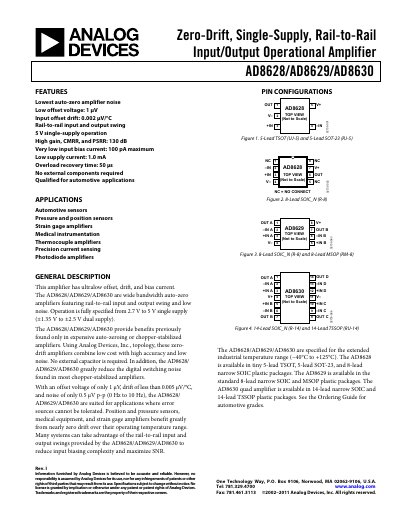
The AD8628, AD8629 and AD8630 are auto‑zero amplifiers that combine low cost with high accuracy. They feature rail‑to‑rail input and output swing, ultra‑low offset voltage (as low as 1 µV), offset drift of 0.002 µV/°C, input bias current down to 100 pA and a supply current of about 1 mA per amplifier. They operate from a single 2.7 V to 5 V supply and provide high gain, CMRR and PSRR.
These devices are suited for automotive sensors, pressure and position sensors, strain‑gage amplifiers, medical instrumentation, thermocouple amplifiers, precision current sensing and photodiode amplification. They are offered in several surface‑mount packages (5‑lead TSOT, 5‑lead SOT‑23, 8‑lead SOIC, 8‑lead MSOP, 14‑lead SOIC, 14‑lead TSSOP) and automotive‑qualified versions are available.
| Offset Voltage (typ) | 1 µV |
|---|---|
| Input Bias Current (typ) | 100 pA |
| Gain‑Bandwidth Product | 2.5 MHz |
The typical offset voltage is 1 µV.
They operate from a single 2.7 V to 5 V supply.
Yes, they are qualified for automotive applications.