
The Nikon E800 is a fixed-stage upright microscope configured for imaging in transmitted light, DIC, and epifluorescence modes. The microscope is equipped with various objectives, including 10x/0.45 PlanApo DIC L ∞/0.17 WD 4.0, 20x/0.75 PlanApo DIC M ∞/0.17 WD 1.0, 40x/0.95 PlanApo DIC M ∞/0.17 WD 0.14, 40x/1.3 PlanFluor DIC H ∞/0.17 WD 0.2 Oil, 60x/1.4 PlanApo DIC H ∞/0.17 WD 0.21 Oil, and 100x/1.3 PlanApo DIC H ∞/0.17 WD 0.2 Oil. The microscope also features a C-CU condenser with a dry lens (swing-out) and DIC lens prisms. Additionally, it has a filter cube slider.
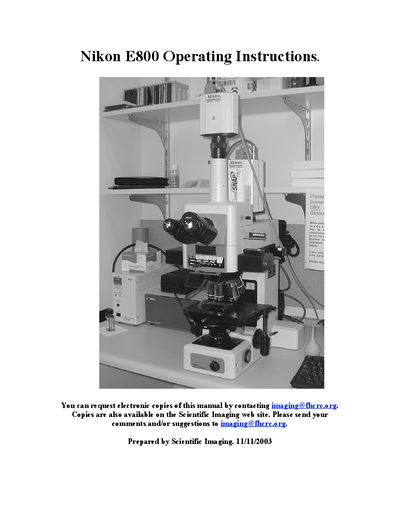
The Nikon E800 is a fixed‑stage upright microscope designed for transmitted light, differential interference contrast (DIC), and epifluorescence imaging. It includes a range of PlanApo and PlanFluor objectives, a C‑CU condenser with 0.9 NA dry lens, and interchangeable filter cubes for various fluorescence channels.
This manual guides users through powering the system, selecting the appropriate light path, operating in different illumination modes, using the Metamorph imaging software with CoolSnap cameras, and properly shutting down and cleaning the microscope after use.
| Objective 10x | 0.45 NA PlanApo |
|---|---|
| Objective 40x | 1.3 NA PlanFluor (oil immersion) |
| Condenser | C‑CU with 0.9 NA dry lens (swing‑out) |
| Camera options | CoolSnap HQ monochrome and CoolSnap cf color CCD cameras |
Power on the mercury arc lamp (if using fluorescence), then power on the microscope, and finally power on the required CoolSnap camera.
Fold one or two sheets of lens tissue, hold by the edges, and gently wipe each objective; use a new tissue if necessary.
Use the front base switch to select transmitted light (DIA) and, if the Hg lamp is on, engage the Hg lamp block by pulling the slider out.