
ST-8833/8855 Professional High Temperature Thermometers 8833/8855 Series compact Infrared Thermometer provide fast, easy, and accurate readings for most surface temperature measurements with Wireless USB Interface (RF 433MHz).
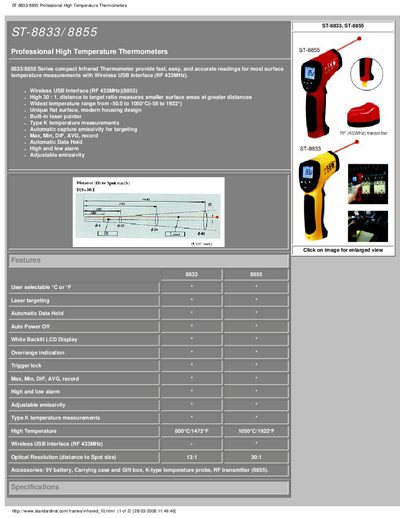
The ST-8833 and ST-8855 are professional high‑temperature infrared thermometers designed for fast, accurate surface temperature readings. They feature a flat housing, built‑in laser pointer, adjustable emissivity, and a backlit LCD display with max/min/average recording and alarm functions.
The devices support wireless data transmission via a 433 MHz RF transmitter and USB interface, include accessories such as a 9 V battery, carrying case, K‑type probe, and offer specifications like a 30:1 distance‑to‑spot ratio, 0.1°C resolution, and less‑than‑1‑second response time.
| Temperature range | -50°C to 1050°C |
|---|---|
| Optical resolution (distance‑to‑spot ratio) | 30:1 |
| Response time | < 1 second |
| Basic accuracy | ±1.5% of reading |
| Emissivity range | 0.10 – 1.0 |
| Size (H×W×D) | 180 mm × 106 mm × 48 mm |
| Weight | 250 g |
It can measure from –50 °C up to 1050 °C (the ST‑8833 version up to 800 °C).
Emissivity can be set between 0.10 and 1.0.
The response time is less than one second.