
This document is a specification for the C3E-16.000-12-1010-X Quartz Crystal Unit 3.2 x 2.5 mm SMD product.
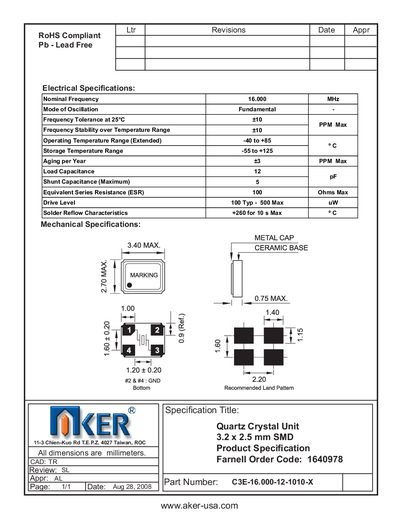
The C3E-16.000-12-1010-X is a 3.2 × 2.5 mm surface‑mount quartz crystal unit designed for high‑frequency applications. It features a nominal frequency of 16 MHz with a fundamental mode of oscillation and a load capacitance of 12 pF.
Key electrical parameters include a frequency tolerance of +10 ppm at 25 °C, stability of +10 ppm over temperature, and an ESR of 100 Ω max. Mechanical specifications list a metal cap height of 3.40 mm, ceramic base dimensions, and recommended land pattern for PCB assembly.
| Nominal Frequency | 16.000 MHz |
|---|---|
| Mode of Oscillation | Fundamental |
| Frequency Tolerance (25 °C) | +10 ppm |
| Frequency Stability over Temperature | +10 ppm Max |
| Operating Temperature Range (Extended) | -40 to +85 °C |
| Storage Temperature Range | -55 to +125 °C |
| Aging per Year | +3 ppm Max |
| Load Capacitance | 12 pF |
| Shunt Capacitance (Maximum) | 5 pF |
| Equivalent Series Resistance (ESR) | 100 Ω Max |
| Drive Level | 100 µW Typ – 500 µW Max |
| Solder Reflow Characteristics | +260 °C for 10 s Max |
The nominal frequency is 16.000 MHz.
It operates from –40 °C to +85 °C (extended range).
The load capacitance is 12 pF.
The equivalent series resistance is up to 100 Ω.