
A 3.579545MHz quartz crystal unit with high frequency stability and low temperature drift performance is provided.
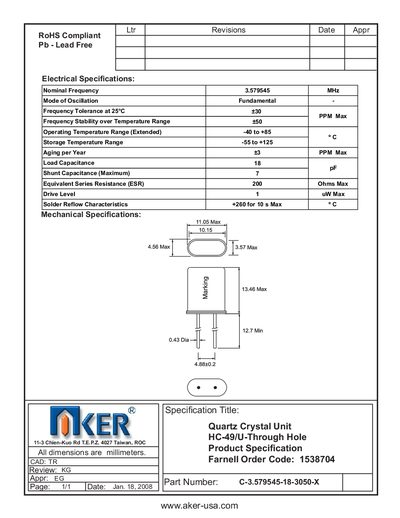
This one‑page datasheet provides the key electrical and mechanical parameters for AKER's HC-49/U quartz crystal unit. It includes frequency, tolerance, temperature ranges, load capacitance, ESR and other performance data needed for circuit designers.
The document also lists mechanical dimensions, marking information and the part number (C-3.579545-18-3050-X). It is intended for engineers selecting a crystal for timing or frequency‑reference applications.
| Nominal Frequency | 3.579545 MHz |
|---|---|
| Mode of Oscillation | Fundamental |
| Frequency Tolerance at 25°C | +30 ppm |
| Frequency Stability over Temperature Range | +50 PPM Max |
| Operating Temperature Range (Extended) | -40 to +85 °C |
| Storage Temperature Range | -55 to +125 °C |
| Aging per Year | +3 PPM Max |
| Load Capacitance | 18 pF |
| Shunt Capacitance (Maximum) | 7 pF |
| Equivalent Series Resistance (ESR) | 200 Ohms Max |
| Drive Level | 1 µW Max |
| Solder Reflow Characteristics | +260 °C for 10 s Max |
| Maximum Length | 11.05 mm |
| Maximum Height | 4.56 mm |
The nominal frequency is 3.579545 MHz.
The crystal requires a load capacitance of 18 pF.
The maximum equivalent series resistance is 200 Ω.
It operates from –40 °C to +85 °C (extended range).