
CS1600 is a low-cost PFC controller from Cirrus Logic for electronic ballast applications. It features a variable frequency discontinuous conduction mode and integrated feedback compensation network, and provides overvoltage protection, overcurrent protection, overpower protection, open- and short-circuit protection, overtemperature protection and brownout protection.
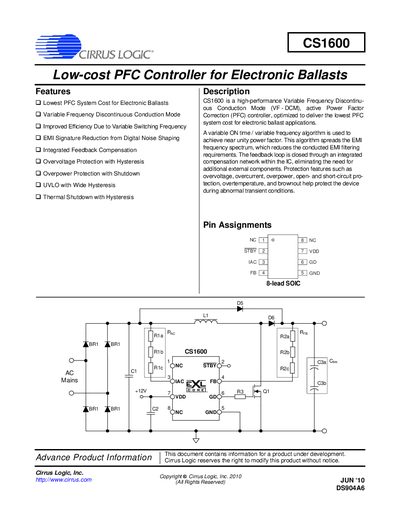
The CS1600 is a digitally controlled Power Factor Correction (PFC) controller that operates in Variable Frequency Discontinuous Conduction Mode (VF‑DCM). It uses an internal compensation network, eliminating the need for external feedback components, and provides features such as over‑voltage, over‑current, over‑power, brown‑out, and thermal protection.
The document includes pin descriptions, absolute maximum ratings, electrical characteristics, typical performance graphs, ordering information, and handling guidelines for the 8‑lead SOIC package (CS1600‑FSZ).
| Maximum Power Dissipation (50 °C) | 600 mW |
|---|---|
| Junction Temperature Range | -40 °C to +125 °C |
The CS1600 includes over‑voltage, over‑current, over‑power, open‑ and short‑circuit, brown‑out, and thermal shutdown protection.
The CS1600 is supplied in an 8‑lead SOIC, lead‑free package (CS1600‑FSZ).