
AD8209 is a high voltage, precision difference amplifier with various features and functions. It can be used in applications such as high-side current sensing, motor control, power management, etc.
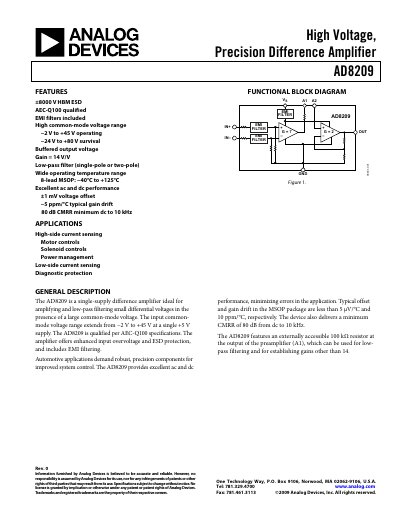
The AD8209 precision difference amplifier is designed for high‑side and low‑side current sensing, motor and solenoid control, and power‑management applications. It operates from a single 5 V supply, supports an input common‑mode range of –2 V to +45 V, and provides a fixed system gain of 14 V/V with optional gain‑adjustment circuitry.
The datasheet includes full electrical specifications, pin descriptions, typical performance graphs, and application circuits such as low‑pass filtering and high‑line current sensing with gain adjustment. Mechanical dimensions and ordering information for the MSOP‑8 package are also provided.
| System Gain | 14 V/V |
|---|---|
| Gain Drift | ±0.3 % (typ) |
| Input Impedance (Differential) | 360 kΩ – 440 kΩ |
| CMRR | ≥80 dB (dc‑10 kHz) |
| Power‑Supply Operating Range | 4.5 V – 5.5 V |
| Quiescent Current (25 °C) | 1.6 mA (typ) |
| Slew Rate | 1 V/µs |
| Input Noise (1 kHz) | 500 nV/√Hz |
The input common‑mode voltage range extends from –2 V to +45 V at a single +5 V supply.
The typical quiescent current is 1.6 mA.
A single‑pole filter is formed by connecting the output of A1 to the input of A2 via the internal 100 kΩ resistor and adding a capacitor from that node to ground.
The absolute maximum supply voltage rating is 12 V continuous.