
AD8556 is a digitally programmable sensor signal amplifier with EMI filters from Analog Devices (ADI). It has a wide operating temperature range of -40°C to +140°C, low input offset voltage, low input offset voltage drift, high CMRR, and can be programmed via a single-wire serial interface. It is suitable for applications such as automotive sensors, pressure and position sensors, precision current sensing and strain gauges.
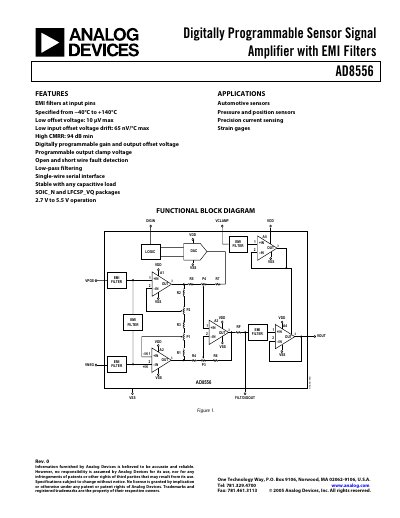
This handbook provides a complete description of the AD8556, a zero‑drift, digitally programmable sensor signal amplifier with internal EMI filters. It covers functional block diagrams, theory of operation, programmable gain and offset, fault detection features, and typical performance characteristics.
The document includes electrical specifications, absolute maximum ratings, pin configurations, thermal resistance data, outline dimensions, and an ordering guide for the 8‑lead SOIC_N and 16‑lead LFCSP_VQ packages. Application notes on EMI/RFI susceptibility and recommended PCB layout practices are also provided.
| Input Offset Voltage (typical) | 10 µV max |
|---|---|
| Input Offset Voltage Drift (typical) | 65 nV/°C |
| CMRR (minimum) | 94 dB |
| Supply Voltage Range | 2.7 V to 5.5 V |
| Programmable Gain Range | 70 to 1,280 |
The typical input offset voltage is 10 µV max.
It operates from –40 °C to +140 °C.
It uses pull‑up and pull‑down current sources on the input pins to detect open‑wire and shorted‑wire conditions.