
The AD797 is an ultra low noise, low distortion operational amplifier ideal for use as a preamplifier.
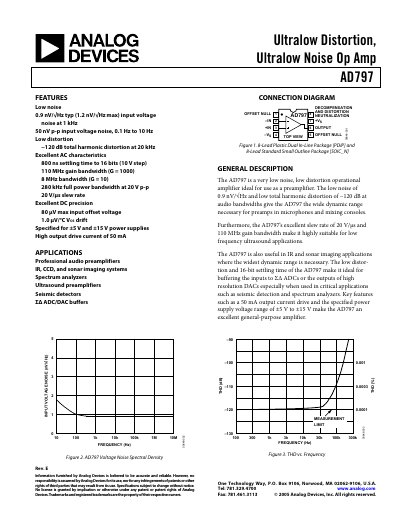
The AD797 is a precision operational amplifier designed for ultra‑low noise and ultra‑low distortion applications such as microphone preamplifiers, professional audio, and low‑frequency ultrasound. It operates from ±5 V to ±15 V supplies and can deliver up to 50 mA output current.
The datasheet provides detailed electrical specifications, absolute maximum ratings, typical performance curves, and application notes covering noise, bandwidth, slew rate, and driving capacitive loads. Ordering information for PDIP and SOIC packages is also included.
| Input voltage noise (1 kHz) | 0.9 nV/√Hz typ |
|---|---|
| Total harmonic distortion (20 kHz) | ‑120 dB |
| Slew rate | 20 V/µs |
| Gain‑bandwidth product | 110 MHz |
| Output drive current | 50 mA |
| Supply voltage range | ±5 V to ±15 V |
| Input offset voltage (max) | 80 µV |
The AD797 has a typical input voltage noise of 0.9 nV/√Hz at 1 kHz.
It can operate from ±5 V up to ±15 V supplies.
The device can source up to 50 mA of output current.
The AD797’s slew rate is 20 V/µs.