
This document describes the features and characteristics of the DS275 Line-Powered RS-232 Transceiver Chip, including low-power serial transmission/reception for battery-backed systems, power stealing from receive signal line to save power, ultra-low static current, variable transmitter level, compatibility with RS-232-E signals, and available package options.
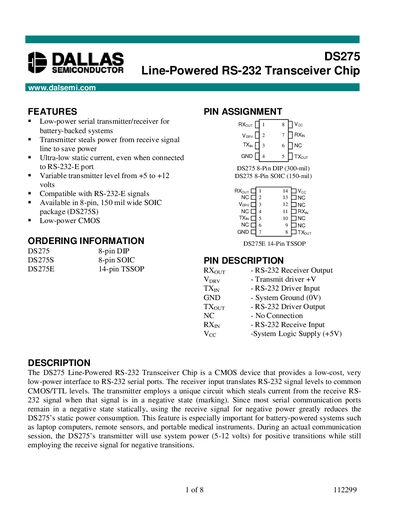
The DS275 is a CMOS line‑powered RS‑232 transceiver designed for battery‑backed devices such as handheld instruments and portable medical equipment. It steals power from the receive line during negative (marking) states, dramatically reducing static power consumption while still providing full RS‑232 functionality.
The datasheet details pin assignments, electrical characteristics, recommended operating conditions, and test circuits for both half‑duplex and full‑duplex operation. It also includes absolute maximum ratings and ordering information for the 8‑pin DIP, 8‑pin SOIC, and 14‑pin TSSOP packages.
| Logic Supply Voltage (Vcc) | Typical 5.0 V (range 4.5‑5.5 V) |
|---|---|
| Transmit Driver Supply Voltage (Vprv) | 5 V – 12 V |
| TXout Low Level | -9.0 V |
| TXout Short‑Circuit Current | Up to 85 mA |
| TXout Slew Rate | ≤ 30 V/µs |
| Propagation Delay | Up to 8 µs |
| RXw Input Low Threshold | Typical 1.2 V |
| RXw Input High Threshold | Typical 2.0 V |
| Input Hysteresis | 0.5 – 0.8 V |
| RXout Output Current @ 2.4 V | -1.0 mA |
| Absolute Maximum Vcc | -0.3 V to +7.0 V |
| Absolute Maximum VDRV | -0.3 V to +13.0 V |
The static current drops to less than 100 nA when Vcc is grounded.
The TXout output is slew‑rate limited to less than 30 V/µs.
Vprv can be supplied with a voltage between 5 V and 12 V.
Vcc may not exceed -0.3 V to +7.0 V.