
The MAX1917 is a synchronous buck controller from MAXIM that can be used for DDR memory. It has a sourcing and sinking current of 25A, a standby current of less than 5µA, and an input voltage range of 1.5V to 3.6V. It has preset switching frequencies of 200kHz/300kHz/400kHz/550kHz, and a variable switching frequency of up to 1MHz.
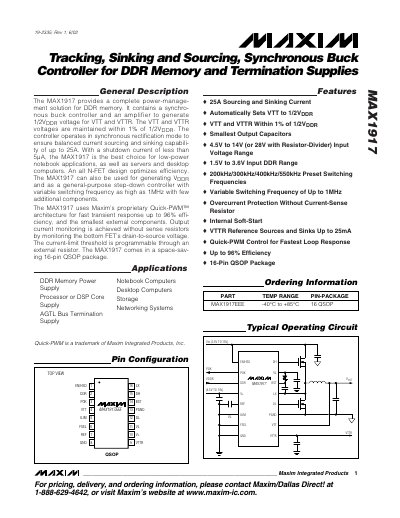
The MAX1917 is a synchronous buck controller designed for DDR memory power‑management, providing VTT and VTTR voltages at half the DDR voltage with tight 1 % accuracy. It supports up to 25 A of sourcing and sinking current and features an all‑N‑FET design for high efficiency.
Key features include a shutdown current below 5 µA, programmable current‑limit via an external resistor, selectable switching frequencies up to 1 MHz, and operation in a 16‑pin QSOP package. The device offers internal VL regulation, VTTR reference output, and comprehensive protection functions.
| Input Voltage Range | 5.5 V to 14 V |
|---|---|
| VTT/VTTR Voltage Accuracy | within 1 % of 1/2 V DDR |
| Efficiency | up to 96 % |
| Package | 16‑Pin QSOP |
The MAX1917 can source and sink up to 25 A of current.
The shutdown current is less than 5 µA.
The device can achieve up to 96 % efficiency.
It is supplied in a 16‑pin QSOP package.