
This data is about the specifications of ADP1828 synchronous buck PWM, step-down, DC-to-DC controller, including voltage range, power range, frequency range, etc.
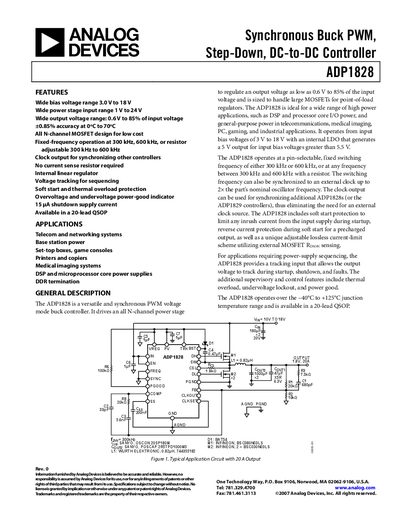
The ADP1828 is a versatile synchronous PWM buck controller designed for high‑power applications such as telecom, set‑top boxes, printers, medical imaging and DSP core supplies. It operates from a bias voltage of 3 V to 18 V and includes an internal 5 V LDO, soft‑start, thermal overload protection and a clock output for synchronizing multiple controllers.
The device is offered in a 20‑lead QSOP package and supports fixed switching frequencies of 300 kHz or 600 kHz, or a resistor‑adjustable range between 300 kHz and 600 kHz. It provides voltage tracking, over‑/undervoltage indicators, and a low‑current shutdown supply.
| Input voltage range (bias) | 3.0 V to 18 V |
|---|---|
| Output voltage range | 0.6 V to 85 % of input voltage |
| Fixed switching frequency | 300 kHz or 600 kHz (adjustable 300‑600 kHz) |
| Quiescent current (no switching) | 15 µA |
| Thermal shutdown threshold | 145 °C |
The device operates with a bias voltage from 3.0 V up to 18 V.
It can run at a fixed 300 kHz or 600 kHz, or be set anywhere between 300 kHz and 600 kHz with a resistor.
The output can be as low as 0.6 V and up to 85 % of the input voltage.