
The AD8314 is a complete RF detector/controller for the measurement and control of RF signals in the frequency range of 0.1 GHz to 2.5 GHz. It provides a wide dynamic range and better accuracy, with excellent temperature stability.
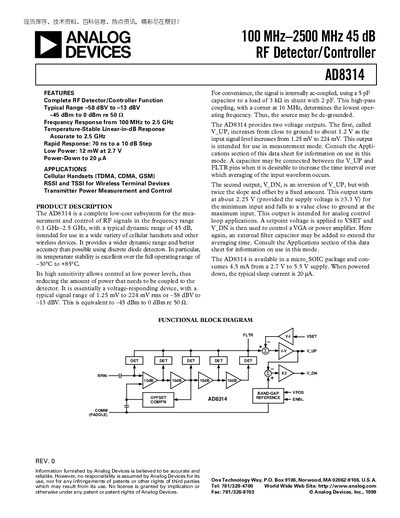
The AD8314 is a low‑cost, logarithmic RF detector/controller covering 100 MHz to 2.5 GHz with a typical dynamic range of 45 dB. It offers two voltage outputs (V_UP for measurement and V_DN for control) and includes internal AC‑coupling, low power consumption, and a power‑down mode.
The device is supplied in an 8‑lead micro‑SOIC package, operates from 2.7 V to 5.5 V, and is rated for –30 °C to +85 °C. Detailed pin descriptions, absolute maximum ratings, and typical performance graphs are provided, along with evaluation‑board configuration options and mechanical dimensions.
| Frequency Range | 0.1 – 2.5 GHz |
|---|---|
| Input Voltage Range | 1.25 – 224 mV rms |
| Supply Voltage (VPOS) | 2.7 – 5.5 V |
| Quiescent Current | 3.0 – 5.7 mA |
| Response Time (10‑90%, 10 dB step) | 70 ns |
| V_UP Output Voltage Range | 0.01 – 1.2 V |
The AD8314 provides a typical dynamic range of 45 dB.
It operates from –30 °C to +85 °C.
It is available in an 8‑lead micro‑SOIC (RM‑8) package.