
The ISL6425 is a highly integrated solution for supplying power and control signals from advanced satellite set-top box (STB) modules to the low noise block (LNB). This device is comprised of a current-mode boost PWM and a low-noise linear regulator, along with the circuitry required for I2C device interfacing and for providing DiSEqC standard control signals to the LNB. A regulated output voltage is available at the output terminal (VOUT) to support the operation of the antenna port in advanced satellite STB applications. The regulated output may be set to either 13V or 18V by use of the voltage select command (VSEL) through the I2C bus. Additionally, to compensate for the voltage drop in the coaxial cable, the voltage may be increased by 1V with the line length compensation (LLC) feature. An enable command sent on the I2C bus provides standby mode control for the PWM and linear combination, disabling the output to conserve power. A current-mode boost converter provides the linear regulator with an input voltage that is set to the required output voltage, plus 1.2V (typ.) to insure minimum power dissipation. This maintains a constant voltage drop across the linear pass element, while permitting an adequate voltage range for tone injection. The device is capable of providing 750mA (typ.).
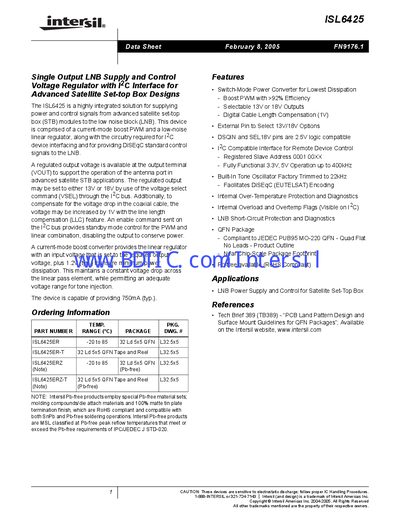
The ISL6425 combines a current‑mode boost PWM converter with a low‑noise linear regulator to provide a regulated LNB supply voltage (13 V or 18 V) and DiSEqC control signals for advanced satellite set‑top box designs. Voltage selection is performed via I²C commands or the SEL18V pin, and a digital cable‑length compensation feature adds 1 V to offset coax loss.
Key specifications include a typical output current of 750 mA, operating supply range 8‑14 V, selectable output voltage, >92 % boost efficiency, 22 kHz tone generation for DiSEqC, and operation over –20 °C to +85 °C in a 5 × 5 mm QFN package.
| Selectable Output Voltage | 13 V or 18 V |
|---|---|
| Typical Output Current | 750 mA |
| Operating Supply Voltage Range | 8 V to 14 V |
| Boost Converter Efficiency | >92 % |
| Tone Frequency (DiSEqC) | 22 kHz |
| Maximum Junction Temperature | 150 °C |
| Package Type | 5 × 5 mm QFN |
| Operating Temperature Range | -20 °C to +85 °C |
The output voltage can be selected via the I²C bus VSEL command or by setting the SEL18V pin high for 18 V.
The device can supply up to 750 mA typical output current.
It generates a 22 kHz tone for DiSEqC encoding.
The ISL6425 operates from –20 °C to +85 °C.