
The X9428 is a low noise/low power/2-wire bus single digitally controlled potentiometer (XDCP) with features such as solid state potentiometer, 2-wire serial interface, register oriented format, low power CMOS, etc.
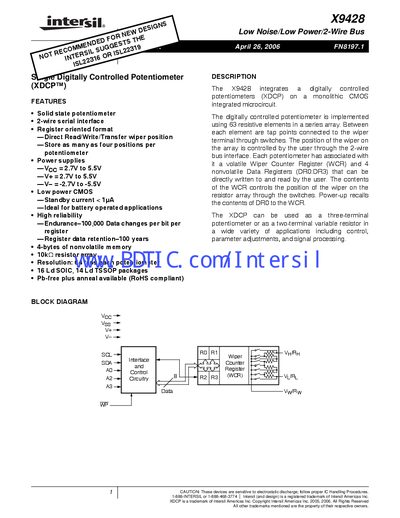
The X9428 is a low‑noise, low‑power digitally controlled potentiometer (XDCP) that integrates 63 resistive elements in a monolithic CMOS microcircuit. It offers a 2‑wire serial interface, non‑volatile memory for up to four stored positions, and a standby current of less than 1 pA, making it suitable for battery‑operated applications.
The document provides a complete description of the device, including features, ordering information for various SOIC and TSSOP packages, pin descriptions, operation principles, serial interface protocol, device addressing, instruction set, and package dimensions.
| Supply voltage V+ | 2.7 V to 5.5 V |
|---|---|
| Supply voltage V- | -2.7 V to -5.5 V |
| Standby current | < 1 pA |
| Resistive elements in array | 63 |
| Maximum devices on 2‑wire bus | 8 |
The standby current is less than 1 pA.
The device contains 63 resistive elements in its series array.
A maximum of 8 devices can occupy the 2‑wire serial bus.
The device address identifier is fixed as 0101b.