
The AT24C64B is a 64K (8192 x 8) 2-wire serial electrically erasable and programmable read only memory (EEPROM) with features such as low-voltage and standard-voltage operation.
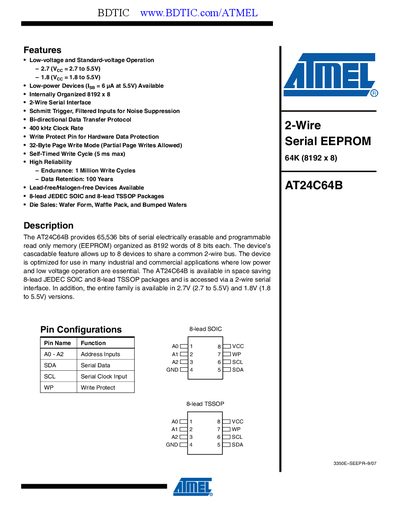
The AT24C64B provides 65,536 bits of EEPROM organized as 8,192 × 8‑bit words. It operates from 1.8 V to 5.5 V (or 2.7 V to 5.5 V) and supports up to eight devices on a common 2‑wire bus. Features include low power consumption, write‑protect pin, and 32‑byte page write mode.
The device offers a 400 kHz serial clock rate, typical read current of 0.4‑1.0 mA and write current of 2‑3 mA at 5 V. It guarantees 1 million write cycles and 100‑year data retention, making it suitable for industrial and commercial applications.
| Operating Voltage | 1.8 V – 5.5 V (or 2.7 V – 5.5 V) |
|---|---|
| Clock Rate | 400 kHz |
| Endurance | 1 Million Write Cycles |
| Data Retention | 100 Years |
| Read Supply Current (5 V, 400 kHz) | 0.4 – 1.0 mA |
| Write Supply Current (5 V, 400 kHz) | 2.0 – 3.0 mA |
| Write Cycle Time | 5 ms |
| Memory Organization | 256 pages of 32 bytes each (8192 × 8 bits) |
Up to eight devices can share a common 2‑wire bus.
The write cycle time is specified as 5 ms.
It operates from 1.8 V to 5.5 V, with a 2.7 V version also available.
The device supports a 400 kHz serial clock rate.