
The document describes the features and characteristics of a product. The product incorporates the ARM926EJ-S™ ARM® Thumb® Processor with DSP instruction extensions and ARM Jazelle® technology for Java® acceleration. It also includes a memory management unit and embedded debug capabilities, as well as a multi-layer AHB bus matrix for large bandwidth transfers, 2-channel DMA, and an external bus interface. The product also features an LCD controller (for AT91SAM9RL64 only) and a USB 2.0 device controller. Overall, the product offers high performance and versatility.
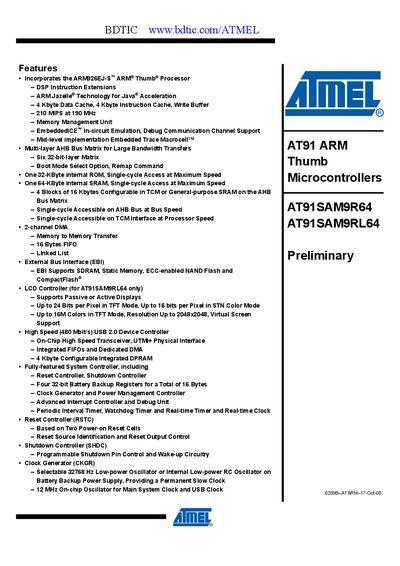
The AT91SAM9RL64 is an ARM926EJ‑S™ microcontroller featuring a 190 MHz core capable of 210 MIPS, 32 KB internal ROM, 64 KB internal SRAM, and a rich set of peripherals including USB 2.0 High‑Speed, LCD controller (RL64 only), AC’97, multiple USARTs, SPI, I²C, PWM, and a 6‑channel 10‑bit ADC with touch‑screen support. Power management includes flexible voltage domains and a backup controller.
The manual contains block diagrams, signal descriptions, register configuration guides, electrical and mechanical characteristics, as well as errata and ordering information, making it a comprehensive reference for hardware designers and firmware developers.
| Core Processor | ARM926EJ‑S™ ARM® Thumb® |
|---|---|
| Maximum Performance | 210 MIPS at 190 MHz |
| Internal ROM | 32 KB, single‑cycle access |
| Internal SRAM | 64 KB, single‑cycle access |
| DMA Channels | 2‑channel DMA controller |
| USB Controller | High‑speed USB 2.0 Device (480 Mbit/s) |
| LCD Controller | Supported on AT91SAM9RL64 only |
| ADC | 6‑channel 10‑bit ADC with touch‑screen interface |
| USARTs | Four universal synchronous/asynchronous receivers/transmitters |
| Power Supply – Core Domains | 1.08 V to 1.32 V |
| Power Supply – Peripheral Domains | 3.0 V to 3.6 V |
It incorporates an ARM926EJ‑S™ ARM® Thumb® processor.
The device runs at up to 190 MHz and delivers 210 MIPS.
Four universal synchronous/asynchronous receiver transmitters (USART) are provided.
Core domains need 1.08 V–1.32 V, while peripheral domains require 3.0 V–3.6 V.