
AD8153 is a 3.2Gbps single buffered switch with 2:1 mux / 1:2 demux function, which can compensate for 40 inches of FR4 cable loss, and operates at a voltage of 3.3V with typical power consumption of 200mW.
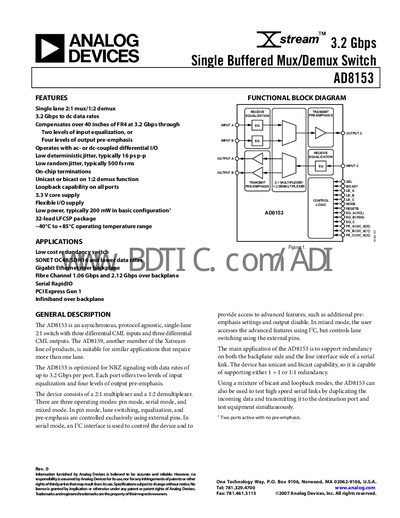
The AD8153 is an asynchronous, protocol‑agnostic single‑lane switch that provides a 2:1 multiplexer and a 1:2 demultiplexer with three differential CML inputs and outputs. It offers two levels of input equalization, four levels of output pre‑emphasis, and loopback capability on all ports, making it suitable for redundancy and testing of high‑speed serial links.
Key specifications include a maximum data rate of 3.2 Gbps per channel, deterministic jitter of 16 ps p‑p, random jitter of 500 fs rms, and operation over a temperature range of –40 °C to +85 °C. The device is supplied by a 3.3 V core and a flexible I/O supply, with typical power consumption of about 200 mW in the basic configuration.
| Data Rate per Channel | 3.2 Gbps |
|---|---|
| Propagation Delay | 640 ps |
| Output Current (no pre‑emphasis) | 16 mA |
| Operating Temperature Range | –40 °C to +85 °C |
| Supply Voltage (VEE) | 3.0‑3.6 V |
The AD8153 supports up to 3.2 Gbps per channel.
It provides two levels of input equalization.
Yes, loopback capability is available on all ports.