
AD7314 is a low voltage, 10-bit digital temperature sensor in 8-lead MSOP package. It contains a band gap temperature sensor and 10-bit ADC to monitor and digitize the temperature reading to a resolution of 0.25∞C. The AD7314 has a flexible serial interface that allows easy interfacing to most microcontrollers.
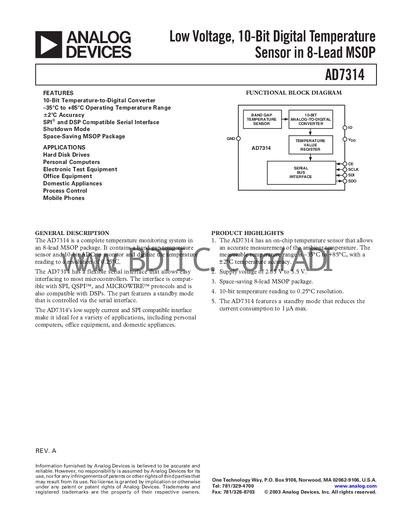
The AD7314 integrates a temperature sensor, a 10‑bit ADC, reference and serial‑interface logic in a compact 8‑lead MSOP (RM‑8) package. It operates from 2.65 V to 5.5 V and communicates via SPI, QSPI™ or MICROWIRE™ protocols, making it suitable for microcontrollers, DSPs and a range of applications such as PCs, office equipment and domestic appliances.
The device offers a standby mode that reduces supply current to 1 µA, a typical accuracy of ±2 °C over –35 °C to +85 °C, and a conversion time of 25 µs. Detailed pin descriptions, timing diagrams, mounting guidelines and typical error graphs are provided to aid designers in implementing the sensor in temperature‑monitoring systems.
| Resolution | 10 bits |
|---|---|
| Accuracy (typical) | ±2.0 °C |
| Supply Current – Normal Mode (Active) | 1 mA |
| Operating Temperature Range | –35 °C to +85 °C |
The device operates from –35 °C to +85 °C.
It is supplied in an 8‑lead MSOP (Mini Small Outline Package, RM‑8).