
AD7626 is a 16-bit, 10MSPS PulSAR differential ADC. It has 16-bit resolution with no missing codes, peak-to-peak voltage of ±4.096V, serial LVDS interface for self-clocked mode and echoed clock mode. AD7626 is suitable for high dynamic range telecommunications, receivers, digital imaging systems, high-speed data acquisition, spectrum analysis and test equipment.
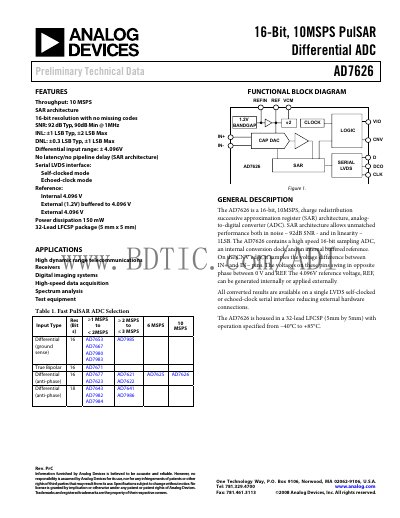
The AD7626 is a 16‑bit, 10 MSPS charge‑redistribution successive‑approximation register (SAR) analog‑to‑digital converter. It offers high‑performance noise (92 dB SNR) and linearity (+1 LSB INL) with a differential input range of ±4.096 V. Data are output over a serial LVDS interface that can operate in self‑clocked or echoed‑clock mode, reducing external wiring.
The device is supplied in a 32‑lead LFCSP package (5 mm × 5 mm) and operates from 5 V (VDD1) and 2.5 V (VDD2) supplies. Power dissipation is 140 mW with the internal reference. Pin configurations provide separate analog supplies, reference buffers, and LVDS clock and data pairs, supporting flexible system designs from –40 °C to +85 °C.
| Resolution | 16 bits |
|---|---|
| Maximum Throughput | 10 MSPS |
| Signal‑to‑Noise Ratio (typ) | 92 dB |
| Power Dissipation (internal reference) | 140 mW |
| Package | 32‑Lead LFCSP (5 mm × 5 mm) |
| Supply Voltages | VDD1 = 5 V, VDD2 = 2.5 V, VIO = 2.5 V |
| Differential Input Range | ±4.096 V |
The AD7626 can sample at up to 10 MSPS.
It uses a serial LVDS interface that can operate in self‑clocked or echoed‑clock mode.
Power dissipation is 140 mW when the internal reference is used.
The device is housed in a 32‑lead LFCSP package measuring 5 mm × 5 mm.