
The ADA4861-3 is a high-speed, low-cost triple op amp with wide bandwidth, high signal-to-noise ratio, and low power consumption.
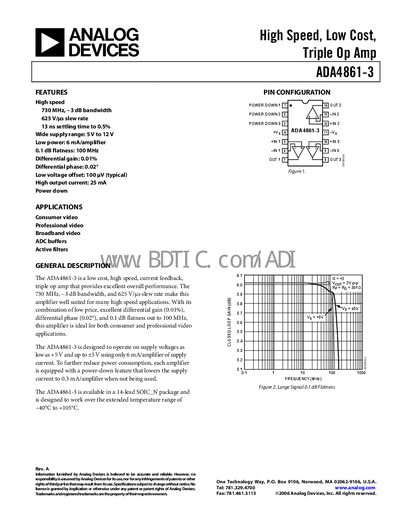
The ADA4861-3 is a current‑feedback, triple operational amplifier offering 730 MHz –3 dB bandwidth, 625 V/µs slew rate, and 13 ns settling time to 0.5 %. It operates from a single supply of 5 V to 12 V, draws 6 mA per amplifier in active mode, and provides up to 25 mA output current. The device is supplied in a 14‑lead SOIC‑N package and is rated for –40 °C to +105 °C. Typical applications include consumer and professional video, broadband video, ADC buffers, and active filters. The document includes pin configuration, absolute maximum ratings, thermal resistance, layout guidelines, and ordering information.
| –3 dB Bandwidth | 730 MHz |
|---|---|
| Slew Rate (Rising) | 625 V/µs |
| Settling Time to 0.5 % | 13 ns |
| Supply Voltage Range | 5 V to 12 V |
| Quiescent Current (Enabled) | 6 mA per amplifier |
| Output Current | 25 mA |
| Differential Gain | 0.01 % |
| Differential Phase | 0.02 ° |
| Voltage Offset (typical) | 100 pV |
It operates from 5 V up to 12 V.
The typical slew rate is 625 V/µs.
Each amplifier draws about 6 mA in active mode.
The device can source or sink up to 25 mA.